
Zero Trust Security & ZTNA Solutions in Egypt
QUICK ANSWER
Zero Trust security replaces implicit network trust with continuous verification: every user and device is authenticated and authorized for each request, with least-privilege access. WASS Technologies helps Egyptian enterprises adopt Zero Trust and ZTNA to replace legacy VPNs, reduce the attack surface, secure remote and hybrid work.
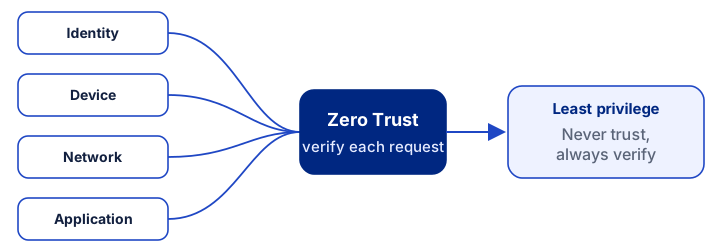
WASS Technologies helps Egyptian enterprises adopt a Zero Trust security model, replacing implicit network trust and legacy VPNs with continuous verification and least-privilege access.
The old security model assumed everything inside the corporate network could be trusted.
Remote work, cloud applications, and modern attacks have broken that assumption. Once an attacker is inside, a flat, trusting network lets them move freely.
Zero Trust flips the model: no user or device is trusted by default. Every access request is verified, every time, based on identity and device health — and users get access only to the specific applications they need.
The Core Principles of Zero Trust
- Verify Explicitly: Authenticate and authorise every access request based on user identity, device posture, and context.
- Least-Privilege Access: Grant the minimum access required for the task, and nothing more.
- Assume Breach: Design as if attackers are already inside, using segmentation to limit how far they can move.
ZTNA vs. Legacy VPN
The most immediate Zero Trust win for most organisations is replacing the VPN. A traditional VPN authenticates a user once and then gives their device broad access to the internal network — so a single compromised laptop can expose everything.
Zero Trust Network Access (ZTNA) is different.
It verifies both the user and the device, then connects them only to the specific applications they are approved to use. Applications are never exposed to the open internet, and a compromised device cannot reach systems it was never granted.
How We Implement Zero Trust
We deploy Zero Trust Network Access using Sophos ZTNA, which integrates with Sophos Central and endpoint protection so that device health is part of every access decision. Our approach is practical and phased:
- Identity foundation: Strengthen authentication and access control through Identity & Access Management and multi-factor authentication.
- Device posture: Ensure only healthy, compliant devices — validated by EDR — can connect.
- Application access: Replace broad VPN access with per-application ZTNA policies.
- Segmentation: Combine with firewall and network segmentation to contain any breach.
Zero Trust for Egyptian Enterprises
As Egyptian organisations support hybrid work and move applications to the cloud, the traditional network perimeter no longer defines the boundary. Zero Trust gives banking, government, and enterprise clients a modern, defensible security posture that protects sensitive systems whether users are in the Cairo office, a branch, or working remotely.
The Pillars of Zero Trust
A complete Zero Trust programme applies verification across several pillars rather than trusting any single control:
- Identity: strong authentication and least-privilege access for every user.
- Devices: only healthy, compliant devices may connect.
- Networks: segmentation and per-application access replace flat, open networks.
- Applications: access is granted per application, and apps are never exposed directly to the internet.
- Data: sensitive data is classified and protected wherever it moves.
Microsegmentation: Containing the Breach
One of Zero Trust's most powerful ideas is to assume a breach will happen and limit how far it can spread.
Microsegmentation divides your network into small, isolated zones so a compromised device in one area cannot reach critical systems in another. Paired with firewall segmentation, it turns a potential enterprise-wide incident into a contained one.
A Phased Path to Zero Trust
Zero Trust is not a product you install overnight; it is a programme delivered in stages.
We typically start where the risk-to-effort ratio is best — replacing VPN access with ZTNA and strengthening identity — then extend to device posture, segmentation, and data controls. Each phase delivers value on its own, so you improve security continuously rather than waiting for a big-bang rollout.
Common Zero Trust Pitfalls
Organisations often stall by trying to do everything at once, by treating Zero Trust as a single vendor purchase, or by tightening controls so abruptly that users are disrupted. We avoid these by scoping carefully, integrating with the tools you already own, and rolling out policies in monitor-then-enforce stages so protection improves without breaking the business.
Frequently Asked Questions (FAQs)
What does Zero Trust actually mean? Zero Trust is a security model built on "never trust, always verify." Instead of assuming everything inside the network is safe, every user and device is continuously verified before being granted access to a specific application.
How is ZTNA different from a VPN? A traditional VPN gives a remote user broad access to the whole network. ZTNA verifies the user and device and grants access only to the specific applications they are approved for, dramatically reducing what an attacker can reach if a device is compromised.
Do we have to replace all our infrastructure? No. Zero Trust is a journey, not a single product. We start with the highest-value controls — identity, device posture, and application-level access — and build out from there on top of your existing environment.
Which vendor do you use for ZTNA? We implement Zero Trust Network Access using Sophos ZTNA, integrated with Sophos Central and your endpoint protection so device health is part of every access decision.
Is Zero Trust only for large enterprises? No. Mid-size Egyptian organisations with remote and hybrid workers benefit just as much, because ZTNA removes the broad network access that legacy VPNs expose.
How long does a Zero Trust rollout take? It is phased. The first phase — replacing VPN access with ZTNA and strengthening identity — can be delivered in weeks, with device posture, segmentation, and data controls following in later stages so security improves continuously.
Does Zero Trust replace my firewall? No. Zero Trust works with your firewall, not instead of it. The firewall handles perimeter defence and segmentation; Zero Trust adds continuous identity- and device-based verification for access to applications.
Related comparison: ZTNA vs VPN
Further reading: What is Zero Trust?
Move to a Zero Trust Model
Replace implicit trust and legacy VPNs with continuous verification and least-privilege access. Start your Zero Trust journey with a practical, phased plan.
Talk to our Zero Trust specialists in Cairo