
Government & Public-Sector Cybersecurity in Egypt
QUICK ANSWER
Government cybersecurity in Egypt protects citizen data and critical public services against disruption and breach. WASS Technologies helps public-sector bodies with continuous monitoring, Zero Trust architecture, and data-sovereignty-aware design that keeps sensitive data protected and, where required, resident within Egypt.
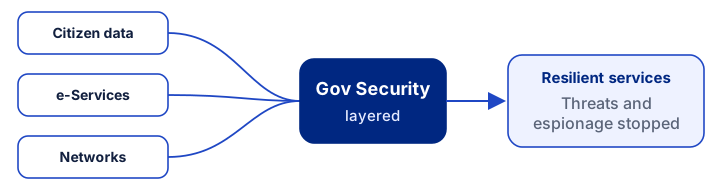
WASS Technologies helps Egyptian government entities and public-sector organisations protect citizen data and critical services, with a focus on monitoring, Zero Trust access, and data sovereignty.
Government bodies hold vast amounts of citizen data and run services the public depends on.
They are also targets for sophisticated, well-resourced attackers. A ransomware readiness assessment is strongly recommended for all public-sector bodies. As Egypt advances its digital-transformation agenda, securing these systems — and keeping sensitive data in trusted hands — becomes a national priority.
Key Cyber Threats Facing the Public Sector
- Advanced persistent threats: sophisticated, targeted intrusions aimed at sensitive data and services.
- Citizen-data breaches: exposure of large volumes of personal information.
- Service disruption: attacks intended to take public services offline.
- Supply-chain and third-party risk: attacks that reach government systems through vendors.
- Legacy infrastructure: ageing systems that are difficult to secure and patch.
Public Sector Benchmark
Sovereign Data Protection: Egypt Law 151/2020 and national cybersecurity frameworks require public sector institutions and government entities to maintain in-country air-gapped backups and encrypted sovereign data residency.
Data Sovereignty and the PDPL
Personal data held by public bodies is governed by Egypt's Personal Data Protection Law (PDPL, Law 151 of 2020), and government workloads frequently require data to remain in-country. We design solutions with data residency in mind — keeping sensitive data on-premises or in-country where required — and build the access, encryption, and monitoring controls that support sovereignty and PDPL obligations.
The Security Stack We Deploy for Government
- Monitoring & detection: SIEM and EDR, backed by 24/7 Managed Detection & Response.
- Access control: Zero Trust and Identity & Access Management to enforce least-privilege access to sensitive systems.
- Resilient infrastructure: secure enterprise infrastructure and disaster recovery designed for data residency.
- Network security: firewalls and segmentation to contain intrusions.
Why Government Bodies Choose WASS Technologies
We combine vendor-certified security expertise with an understanding of the sovereignty and regulatory needs of Egyptian public-sector organisations. We design controls that keep sensitive data in trusted, in-country hands, provide the continuous monitoring needed to detect advanced threats, and are delivered and supported entirely by a local team.
Data Sovereignty in Practice
For government workloads, where data physically resides and who can access it are not abstract questions.
Sovereignty means sensitive citizen data stays under national control rather than in unknown foreign jurisdictions. In practice we deliver this through on-premises or in-country hosting for sensitive systems, encryption that keeps data unreadable if intercepted, and strict access controls that record exactly who accessed what — the concrete measures behind the word "sovereignty."
Defending Against Advanced, Persistent Threats
Public-sector bodies face some of the most capable attackers, who are patient, well-resourced, and prepared to stay hidden for months.
Signature-based defences alone cannot stop them. We deploy behaviour-based detection through EDR and SIEM, backed by 24/7 managed detection and response, so that the subtle signs of a sophisticated intrusion are caught and contained early rather than discovered after the damage is done.
Securing Digital Government Services
As more public services move online, each new digital service is both a convenience for citizens and a new target. We help secure these services with Zero Trust access controls, resilient infrastructure, and protection against the availability attacks that aim to take public services offline — so citizens can rely on them.
A Phased Approach for the Public Sector
Government environments are large and complex, often mixing modern and legacy systems. We take a phased approach — assessing the current posture, protecting the most sensitive systems first, and expanding coverage in stages — so security improves steadily without disrupting essential public services.
Protecting the Human Layer
Technology alone does not stop attacks that target people.
Public-sector staff are frequently targeted through phishing and social engineering aimed at gaining a foothold in sensitive systems. We complement technical controls with email security and awareness so that employees become a line of defence rather than the weakest link, reducing the credential theft that underpins most modern breaches.
Frequently Asked Questions (FAQs)
What cybersecurity do government entities in Egypt need? Public-sector bodies need strong monitoring and detection (SIEM and EDR), Zero Trust access control, resilient infrastructure, and data-sovereignty-aware design — protecting citizen data and critical services against sophisticated threats.
How is government data governed in Egypt? Government-held personal data falls under Egypt's Personal Data Protection Law (PDPL, Law 151 of 2020), and public-sector bodies often require data to be kept in-country. We design controls and hosting that support data residency and sovereignty.
Can you support data sovereignty requirements? Yes. Where required, we keep sensitive data on-premises or in-country and design access and monitoring controls so that data handling aligns with Egyptian sovereignty and PDPL expectations.
How do you defend against advanced, targeted attacks? Public-sector bodies face sophisticated, persistent threats, so we combine continuous monitoring, threat detection, response, Zero Trust access, and strong segmentation to detect and contain intrusions early.
Do you provide 24/7 monitoring for government systems? Yes. Our Managed Detection and Response service delivers round-the-clock monitoring and response from an Egypt-based SOC.
Secure Public-Sector Systems
Protect citizen data and critical services with monitoring, Zero Trust, and data-sovereignty-aware design.
Talk to our public-sector security team