
Managed Detection & Response (MDR) & SOC Services in Egypt
QUICK ANSWER
Managed Detection and Response (MDR) is a service that combines security technology with a 24/7 team of analysts who monitor, hunt for, and respond to threats on your behalf. WASS Technologies delivers MDR from an Egypt-based SOC, giving Egyptian organizations enterprise-grade detection without building their own security team.
Managed Detection & Response (MDR) and SOC Services in Egypt
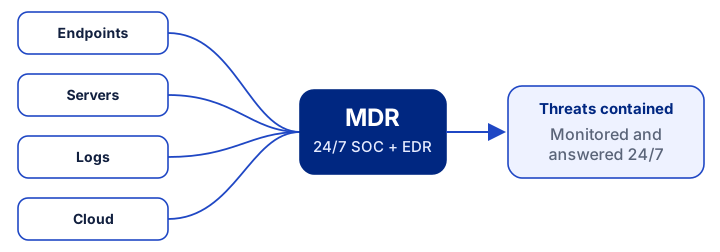
WASS Technologies runs threat detection and response for Egyptian enterprises through a managed service backed by an Egypt-based security team, so threats are caught and contained around the clock — even while your staff sleep.
Modern security tools generate a flood of alerts. Detecting a threat is only half the job; someone has to investigate every alert, decide what is real, and respond fast enough to stop damage. Most organisations do not have the analysts to do this 24 hours a day.
Managed Detection and Response (MDR) solves that gap. Through partner MDR from Sophos and Kaspersky, a 24/7 SOC team combines leading detection technology with human expertise to monitor, hunt, investigate, and respond on your behalf, while WASS handles deployment, onboarding, and coordination.
What MDR Includes
- 24/7 Monitoring: Continuous watch over endpoints, servers, and key log sources by the partner SOC's 24/7 analysts.
- Threat Hunting: Proactive searches for attacker behaviour that automated tools alone would miss.
- Alert Triage & Investigation: Every meaningful detection is investigated by a human, filtering out noise so you are only told what matters.
- Incident Response: When a real threat is confirmed, we act — isolating affected machines, stopping malicious processes, and guiding remediation.
- Reporting: Regular reporting on what was detected, what was contained, and how your posture is trending.
MDR vs. EDR vs. Building Your Own SOC
These options are often confused, so it helps to be precise:
- EDR (the technology): Detects and records suspicious activity on endpoints. Powerful, but it still needs analysts to act on what it finds.
- Building your own SOC: Effective but expensive — it means hiring, training, and retaining scarce security analysts to cover every hour of every day.
- MDR (the managed service): Gives you the outcome of a 24/7 SOC without the cost of building one. You get the technology and the people as a service.
By outsourcing detection and response to WASS Technologies, you avoid the ongoing cost of recruiting, training, and retaining rare cybersecurity talent, while still getting round-the-clock protection.
The Technology Behind MDR
MDR is delivered on proven partner platforms whose 24/7 SOC teams do the monitoring, coordinated locally by WASS:
- Sophos MDR: A mature managed detection and response service with a large global threat-intelligence base, integrated with Sophos Intercept X.
- Kaspersky Managed Security: Managed detection and response backed by Kaspersky's threat research.
We also integrate MDR with your existing SIEM and vulnerability assessment programmes so detection, log correlation, and proactive testing reinforce each other.
Why Egyptian Enterprises Choose Managed Detection and Response
For banks, financial services, and critical-infrastructure operators, regulators increasingly expect active threat detection, not just perimeter defence. A managed SOC provides the continuous monitoring, documented response, and reporting that support these expectations under the Central Bank of Egypt cybersecurity framework, while giving lean IT teams enterprise-grade coverage they could not staff alone.
Inside the MDR Workflow
A managed SOC is only as good as its process. Every alert that reaches the partner SOC analysts moves through a defined workflow so nothing is missed and nothing is over-reacted to:
- Detect: Telemetry from your endpoints, servers, and key systems is continuously analysed for suspicious behaviour.
- Triage: An analyst reviews each meaningful detection, separating genuine threats from false positives so your team is not flooded with noise.
- Investigate: Confirmed suspicious activity is scoped — what happened, which systems are affected, and how far it has spread.
- Respond: We contain the threat, isolating affected machines and stopping malicious processes, then guide remediation.
- Report: You receive a clear account of what was found, what was done, and what to improve.
What We Monitor
Effective detection needs visibility across the places attackers operate. The MDR service watches:
- Endpoints and servers: process activity, persistence, and suspicious behaviour through EDR telemetry.
- Identity: abnormal logins, privilege escalation, and account misuse.
- Network and cloud: command-and-control traffic and risky activity in your cloud environments.
MDR vs. MSSP: What's the Difference?
A traditional Managed Security Service Provider (MSSP) typically manages your security devices and forwards alerts to your team. MDR goes further: it takes ownership of detection and response outcomes, with analysts actively hunting for threats and acting on them rather than just forwarding notifications. If your goal is fewer breaches rather than more alerts, MDR is the model that delivers it.
Onboarding and Reporting
We begin every MDR engagement by understanding your environment, connecting to your endpoint and log sources, and agreeing response authority and escalation paths. From there you receive regular reporting on detections, incidents, and posture trends, plus immediate contact when a critical threat is confirmed — giving your leadership documented evidence of active monitoring.
Frequently Asked Questions (FAQs)
What is the difference between MDR and EDR? EDR is the technology that detects suspicious activity on your endpoints. MDR is the managed service on top of it: a 24/7 partner SOC team monitors, investigates, and responds to those detections for you, so you get outcomes rather than just more alerts.
Do I still need my own IT team with MDR? Yes, but they are freed from chasing alerts around the clock. MDR handles detection and response; your team focuses on IT operations and strategic projects while we watch for threats.
How fast do you respond to a critical alert? Response targets are defined in your MDR service level agreement based on severity, with critical incidents prioritised for immediate investigation and containment.
Which platforms power your MDR service? We deliver managed detection and response built on Sophos MDR and Kaspersky managed security services, with onboarding and integration coordinated by our Egypt-based team, alongside your existing EDR and SIEM where present.
Can MDR help with regulatory audits? Yes. Continuous monitoring, documented incident handling, and reporting support the active-threat-detection expectations that Egyptian regulators and auditors increasingly ask for.
What happens when you detect a real incident? The partner SOC analysts investigate to scope the threat, then contain it — isolating affected machines and stopping malicious processes — and contact your team immediately with clear guidance on remediation and recovery.
How do you onboard a new MDR client? We connect to your endpoint and log sources, agree escalation paths and response authority, and tune detections to your environment. Most organisations are fully onboarded within a couple of weeks.
Related comparison: MDR vs EDR · EDR vs Antivirus
Further reading: What Is a SOC? · SIEM vs SOAR vs XDR
Get 24/7 Threat Detection and Response
Stop drowning in alerts. Let our Egypt-based SOC detect, investigate, and respond to threats for you, around the clock.
Related: Telecom & ISP Cybersecurity · Ransomware Readiness Assessment · Threat Intelligence
Talk to our Egypt-based SOC team