
Backup vs Disaster Recovery in Egypt
QUICK ANSWER
Backup is a copy of your data used to restore individual files, while disaster recovery is the full plan and infrastructure to resume business operations after an outage. Backup protects data; disaster recovery protects operations, with defined recovery time (RTO) and recovery point (RPO) objectives. Most organizations need both.
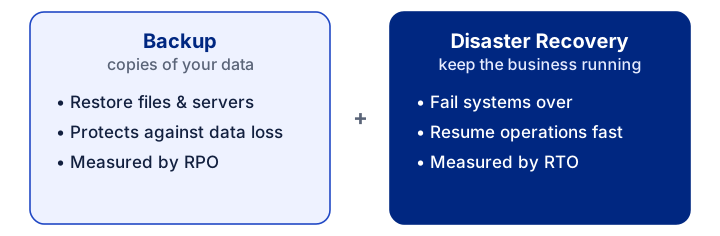
Backup and disaster recovery are often used interchangeably, but they answer two different questions: "Can I get my data back?" and "Can my business keep running?" You need both.
A backup copies your data so you can restore it. Disaster recovery (DR) is the broader capability to bring your whole environment — systems, applications, and operations — back online after a disruption, within defined time and data-loss targets. Confusing the two is a common and costly mistake.
At a Glance: Backup vs Disaster Recovery
| Backup | Disaster Recovery | |
|---|---|---|
| Purpose | Keep recoverable copies of data | Restore full operations after disruption |
| Scope | Files, databases, systems | Whole environment, infrastructure, processes |
| Measured by | Recovery point (how much data) | RTO & RPO (recovery speed + data loss) |
| Answers | "Can I get the file back?" | "Can the business keep running?" |
| Standalone? | A data copy only | Uses backups as its foundation |
| Best for | Data-protection baseline | Business continuity |
Recovery Benchmark
Under 15 Minutes RTO: Continuous replication and automated disaster recovery failover achieve Recovery Time Objectives (RTO) under 15 minutes, compared to 24 to 72 hours for traditional tape or cold backup restores (ESG Data Resilience Study).
What Backup Covers
Backup ensures you have clean, recoverable copies of your data — ideally following the 3-2-1 principle and, against ransomware, with immutable copies attackers cannot alter. It answers the question of whether you can retrieve data after loss, corruption, or attack.
What Disaster Recovery Adds
Disaster recovery goes further. It is the tested plan and technology to resume operations within your Recovery Time Objective (RTO) and Recovery Point Objective (RPO) — covering failover, replication, runbooks, and the infrastructure needed to keep critical systems available. A backup on its own does not tell you how fast you can be operational again; DR does.
Which Should You Choose?
- You only have backups today: your data is protected, but your ability to recover operations quickly is untested — a real risk for any business that cannot tolerate downtime.
- You run mission-critical or regulated systems: you need disaster recovery with defined RTO/RPO, built on a solid backup foundation.
- You face ransomware risk (everyone does): you need immutable backups and a tested recovery process, because attackers target backups directly.
How WASS Technologies Helps
We design both layers for Egyptian enterprises using trusted solutions from Veeam, Acronis, and Veritas: enterprise backup solutions with immutable, ransomware-resilient copies, and full disaster recovery built around your RTO and RPO — helping financial institutions under Central Bank of Egypt oversight and other regulated organisations prove that critical data can actually be recovered.
Understanding RTO and RPO in Practice
Two numbers drive every disaster recovery plan. Your Recovery Time Objective (RTO) is how long you can afford to be down — minutes for a core banking system, perhaps a day for an internal file share. Your Recovery Point Objective (RPO) is how much data you can afford to lose — measured as the gap between your last usable copy and the moment of failure.
Backups influence your RPO; a full DR capability is what lets you actually meet your RTO. Setting these targets per system, by criticality, is the first step in any serious plan.
The 3-2-1 Rule and Immutable Backups
A resilient backup strategy follows the 3-2-1 principle: three copies of your data, on two different media, with one kept off-site. Against ransomware, one more property matters most — immutability. An immutable backup cannot be altered or deleted, even by an attacker who has stolen administrator credentials, because modern ransomware deliberately hunts for and destroys backups first.
Without an immutable copy, your recovery plan can be wiped out in the same attack it is meant to survive.
Testing: The Step Most Organisations Skip
A backup you have never restored is only an assumption. The most common and painful discovery during a real incident is that backups were incomplete, corrupted, or far slower to restore than expected.
Disaster recovery includes regular, documented recovery testing so you know — before a crisis — that your systems come back within your RTO. This is exactly the kind of evidence regulators and auditors increasingly ask Egyptian organisations to demonstrate.
Backup and Disaster Recovery in the Cloud
Cloud changes where copies live but not the principles. We design hybrid strategies that combine on-premises speed with cloud durability and off-site protection, and, where data residency matters, keep sensitive copies in-country in line with Egypt's Personal Data Protection Law. The result is recovery that is both resilient and compliant.
Frequently Asked Questions (FAQs)
Is a backup the same as disaster recovery? No. A backup is a copy of your data; disaster recovery is the plan and capability to restore full business operations after a disruption. Backups are a foundation of DR, but DR covers much more.
Can I have backup without disaster recovery? Yes, and many organisations do — but it leaves a gap. You may be able to recover a file, yet still be unable to bring critical systems back online fast enough to keep the business running.
What are RTO and RPO? RTO (Recovery Time Objective) is how quickly you must be back online; RPO (Recovery Point Objective) is how much data you can afford to lose. DR planning is built around these targets.
Do I need both backup and disaster recovery? Yes. Backup protects your data; disaster recovery protects your ability to operate. Regulated organisations in Egypt are increasingly expected to demonstrate both.
How does ransomware change this? Ransomware makes immutable backups and tested recovery essential — attackers now target backups directly, so both a clean copy and a proven recovery process are needed.
Further reading: How to Build a Disaster Recovery Plan
Protect Data and Operations
Get a backup and disaster recovery assessment built around your real recovery targets.
Talk to our data protection team across Egypt