
PAM vs IAM: What Is the Difference?
QUICK ANSWER
IAM (Identity and Access Management) governs who can access what across all your users and applications. PAM (Privileged Access Management) is a specialised, higher-assurance layer that secures the small number of powerful accounts — administrators, root, service accounts — that attackers target most. IAM is broad; PAM is deep. Most enterprises need both.
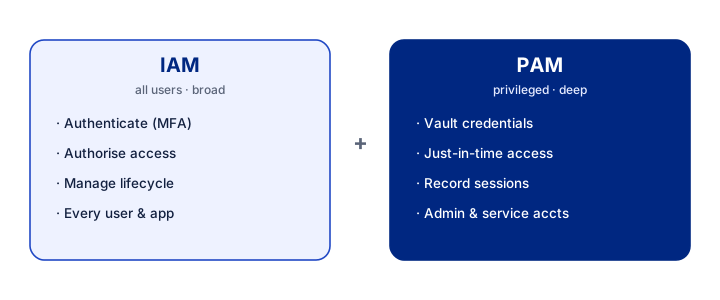
“IAM” and “PAM” are often used loosely, but they solve different problems. Understanding the difference helps you invest in the right controls for your biggest risks. This guide explains each, how they compare, and how they work together.
What Is IAM?
Identity and Access Management (IAM) is the discipline of managing digital identities and their access across your organisation. It covers how users are created, authenticated (including multi-factor authentication), authorised for the right applications and data, and de-provisioned when they leave. IAM is about giving every user appropriate, well-governed access — efficiently and securely — across your whole application estate.
Privileged Credential Benchmark
80% of Enterprise Breaches: Involve compromised, unmanaged, or abused administrative credentials and root access tokens, making PAM a top-tier security priority (Forrester Identity Report).
What Is PAM?
Privileged Access Management (PAM) focuses on the accounts with elevated rights: system administrators, root, database and service accounts, and application credentials. These accounts can change configurations, access sensitive data and disable security — so they are the accounts attackers most want. PAM vaults their credentials, enforces least-privilege and just-in-time access, and records privileged sessions for accountability.
The Key Differences
- Scope — IAM covers all users; PAM covers only privileged accounts.
- Risk focus — IAM manages access broadly; PAM concentrates on the accounts that do the most damage if abused.
- Controls — IAM handles authentication, authorisation and lifecycle; PAM adds credential vaulting, session recording and just-in-time elevation.
- Assurance level — PAM applies stronger, higher-assurance controls because the stakes are higher.
How PAM and IAM Work Together
The two are complementary, not competing. IAM provides the foundation — every identity known, authenticated and given the right access. PAM sits on top for the highest-risk accounts, adding the extra control and monitoring they demand. Together with Active Directory security — protecting the directory these identities live in — they form a layered identity-security strategy. A gap in any one leaves the others exposed.
A Simple Way to Think About It
Picture your organisation as a building. IAM is the access-card system that decides which employees can enter which rooms — it governs everyone. PAM is the extra control around the few master keys that open every door and the server room: those keys are locked in a monitored safe, signed out only when needed, and every use is recorded.
You need the card system for everyone, and special protection for the master keys — because it is the master keys an intruder really wants.
Which Do You Need — and When?
Almost every organisation needs both over time, but priorities differ. If your users lack consistent authentication and access governance, IAM is foundational. If your administrator, service and application accounts are shared, over-permissioned and unmonitored, PAM often delivers the fastest reduction in breach risk. WASS Technologies helps Egyptian enterprises assess their identity risk and sequence PAM and IAM sensibly, using Quest and Symantec.
Common Identity-Security Mistakes
Whichever you start with, a few mistakes recur. The first is treating identity as a one-time project rather than an ongoing programme — access creeps, privileges accumulate, and old accounts linger unless they are continuously reviewed. The second is protecting users but neglecting non-human identities: service accounts, application credentials and automation, which often hold powerful access yet are rarely rotated or monitored.
The third is enforcing strong controls for employees while leaving third-party and vendor access loosely governed. The fourth is deploying IAM or PAM tools but never integrating them with monitoring, so misuse goes unseen. Avoiding these comes down to governance and visibility, not just technology.
WASS helps Egyptian organisations build an identity-security programme that covers human and non-human identities, employees and third parties, with IAM and PAM working together and feeding your detection tools.
Frequently Asked Questions (FAQs)
Is PAM part of IAM? PAM is a specialised discipline within the broader identity space — IAM governs all users; PAM applies stronger controls to privileged accounts.
Do I need both PAM and IAM? Most enterprises do — IAM gives every user governed access; PAM tightly controls the powerful accounts that cause the most damage.
Which should I implement first? It depends on your biggest risk; if unmanaged admin and service accounts are the main exposure, PAM often gives the fastest risk reduction.
Learn more: Privileged Access Management · Identity & Access Management · Active Directory Security
Secure Your Identities and Privileged Access
Ask our team across Egypt for an identity-security review — we help you prioritise IAM and PAM based on where your real risk is, using Quest and Symantec.
Talk to our team across Egypt