
ZTNA vs VPN: The Move to Zero Trust
QUICK ANSWER
A VPN grants a connected user broad access to the whole network, while ZTNA (Zero Trust Network Access) verifies identity and device for every request and grants access to specific applications only. ZTNA reduces the attack surface, limits lateral movement, and scales better for remote and hybrid work.
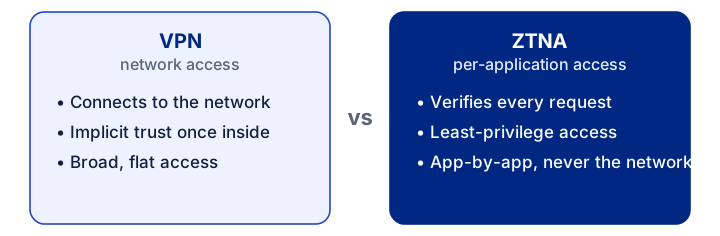
Virtual Private Networks (VPNs) have connected remote workers for decades, but they were built for a world with a clear network perimeter. Zero Trust Network Access (ZTNA) is the modern replacement. Here is how they differ.
The core problem with a VPN is trust: once a user connects, their device is typically trusted with broad access to the internal network. If that device is compromised, an attacker inherits the same broad access. ZTNA removes that implicit trust.
At a Glance: ZTNA vs VPN
| Traditional VPN | ZTNA | |
|---|---|---|
| Trust model | Trusted after login | Never trust, always verify |
| Access granted | The whole network | Per-application only |
| Application exposure | Apps reachable on the network | Apps hidden from the internet |
| Device posture | Usually not checked | Continuously verified |
| Lateral movement risk | High | Minimal |
| Best for | Legacy remote access | Modern secure access / Zero Trust |
Lateral Movement Benchmark
82% of Ransomware Spread: Relies on broad internal network visibility granted by legacy VPN tunnels; ZTNA micro-segmentation restricts access exclusively to authorized applications (Gartner ZTNA Market Guide).
How a VPN Works — and Where It Falls Short
A VPN creates an encrypted tunnel and, after authenticating the user, places their device on the internal network. That is simple and familiar, but it means one stolen laptop or password can expose everything the network can reach. VPNs also struggle to check whether the connecting device is healthy.
How ZTNA Works
ZTNA verifies both the user and the device, then connects them only to the specific applications they are approved to use. Applications are never exposed directly to the internet, and access decisions can factor in device health. A compromised device simply cannot reach systems it was never granted — the essence of a Zero Trust model.
Which Should You Choose?
- You rely on a legacy VPN for remote access: you are carrying broad-access risk that modern attacks exploit through lateral movement.
- You support remote or hybrid staff: ZTNA gives them secure, per-application access without exposing the whole network.
- You are adopting Zero Trust: replacing the VPN with ZTNA is usually the first, highest-value step.
How WASS Technologies Helps
We implement Zero Trust Network Access using Sophos ZTNA, integrated with your endpoint protection and firewall, and we phase it in alongside your existing access so you improve security without disrupting users.
Why the Network Perimeter Disappeared
VPNs were designed for a world where employees sat inside an office and "the network" had a clear edge. That world is gone. Staff now work from home and on the move, applications live in the cloud as much as the data centre, and the idea of a single trusted perimeter no longer matches reality.
When everything is outside the old perimeter, trusting anything simply because it "got in" becomes a liability rather than a convenience.
The Lateral Movement Problem
The greatest risk of legacy VPN access is lateral movement across the corporate network following a single endpoint compromise.
Zero Trust Network Access (ZTNA) eliminates lateral risk by granting least-privilege access strictly to specific authorized applications rather than the entire subnet.
ZTNA and the Broader Zero Trust Model
Replacing the VPN with ZTNA is usually the first and most visible step in a Zero Trust programme, but it is not the whole story. Full Zero Trust also verifies device health, enforces least-privilege identity through Identity & Access Management, and segments the network to contain any breach. ZTNA delivers an immediate, tangible win while setting the foundation for that wider model.
Migrating from VPN to ZTNA
You do not have to switch overnight. We typically start by moving the highest-risk access — third parties, administrators, and sensitive applications — to ZTNA, run it alongside the existing VPN, and expand coverage in stages before retiring the VPN entirely. Each phase reduces risk on its own, so security improves continuously rather than hinging on one disruptive cutover.
Frequently Asked Questions (FAQs)
What is the difference between ZTNA and a VPN? A VPN authenticates a user once and gives their device broad access to the network. ZTNA verifies the user and device continuously and grants access only to the specific applications they are approved for.
Is ZTNA more secure than a VPN? Yes, for most use cases. By removing broad network access and hiding applications from the open internet, ZTNA dramatically reduces what an attacker can reach if a device is compromised.
Do I have to replace my VPN immediately? No. Most organisations phase ZTNA in — starting with the highest-risk access — and retire the VPN over time rather than in a single cutover.
Does ZTNA work for remote and hybrid staff? Yes. ZTNA is designed for modern remote and hybrid work, giving users secure access to just the applications they need from anywhere, without exposing the whole network.
Which vendor do you use for ZTNA? We implement ZTNA using Sophos ZTNA, integrated with endpoint protection so device health is part of every access decision.
Replace Legacy VPN Access
Move from broad VPN trust to per-application Zero Trust access, phased to fit your environment.
Talk to our Zero Trust specialists in Cairo