
What Is a SOC (Security Operations Centre)?
QUICK ANSWER
A SOC (Security Operations Centre) is a team and facility that monitors an organisation's IT around the clock to detect, investigate, and respond to cyber threats. It combines skilled analysts, defined processes, and tools such as SIEM and EDR to catch attacks early — run either in-house or as a managed service.
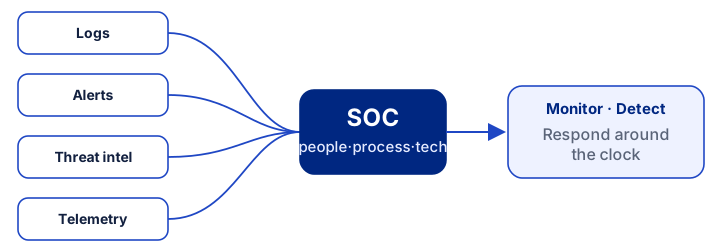
Every organisation connected to the internet is a target, and attacks rarely arrive at a convenient hour. A Security Operations Centre, or SOC, exists to close that gap. It is the function responsible for watching your systems continuously, spotting the early signs of an attack, and coordinating the response before a minor intrusion becomes a major breach.
For businesses in Egypt weighing how to mature their cyber defences, understanding what a SOC is — and what it takes to run one — is an essential first step.
📑 ON THIS PAGE
What a SOC Actually Does
A SOC is best understood by its responsibilities rather than any single product. At its core it delivers a handful of tightly linked functions:
- Continuous monitoring: collecting and watching activity from endpoints, servers, network devices, and cloud services, usually through a SIEM.
- Detection and triage: separating genuine threats from the constant noise of benign alerts, and ranking them by severity.
- Incident response: containing, investigating, and remediating confirmed incidents to limit damage.
- Threat hunting: proactively searching for attackers who have slipped past automated defences.
- Reporting and compliance: producing the audit trails and evidence that regulators such as the Central Bank of Egypt increasingly expect.
The People, Process, and Technology Behind a SOC
A working SOC rests on three pillars.
The first is people: analysts are usually organised in tiers — junior analysts triage incoming alerts, more senior analysts investigate and respond, and the most experienced hunt for hidden threats and lead major incidents, all coordinated by a SOC manager. The second is process: documented playbooks, clear escalation paths, and response-time targets that make the team's actions consistent and repeatable rather than improvised under pressure.
The third pillar is technology. A SIEM typically acts as the nerve centre, correlating data from across the environment, while endpoint detection and response (EDR) provides deep visibility on servers and workstations. Threat-intelligence feeds add context about known attackers, and many modern SOCs add automation to handle repetitive tasks and unify signals from multiple layers — a topic covered in our guide to SIEM vs SOAR vs XDR.
SOC vs SIEM vs MDR: How They Relate
These three terms are often used interchangeably, but they describe different things. A SIEM is a tool. A SOC is the team and process that uses that tool, along with others, to defend the organisation. MDR (Managed Detection and Response) is a way to consume SOC capability as a service — instead of building your own centre, a specialist provider monitors and responds on your behalf.
Owning a SIEM without a SOC to act on its alerts is a common and costly mistake: the technology generates warnings that nobody investigates.
Why Round-the-Clock Coverage Matters
Attackers deliberately operate outside business hours. A breach that begins late on a Thursday night may run undetected until Sunday if no one is watching, and the longer an intruder stays inside a network, the more damage they can do — encrypting backups, stealing data, and moving from one system to the next.
SOC Performance Benchmark
Under 1 Hour MTTR: Mean time to respond and contain active intrusions drops from 200+ days to under 60 minutes when organizations deploy 24/7 Managed Detection and Response (MDR) operations (ESG Global Benchmark).
The value of a SOC lies precisely in compressing that window: catching the first suspicious action and responding in minutes rather than days.
This is why continuous coverage, not just good tooling, is the defining feature of a mature security operation.
What a SOC Is Not
It helps to clear up two misconceptions. A SOC is not simply a piece of software you buy and switch on — the tools are only as effective as the people and processes around them.
Nor is it only for large enterprises: the threats a SOC defends against, from ransomware to business email compromise, target organisations of every size, and Egyptian small and mid-sized businesses are frequently hit precisely because attackers expect them to be less prepared.
What differs by size is how you obtain SOC capability, not whether you need it.
Do You Actually Need a SOC?
Round-the-clock coverage is deceptively expensive. Genuinely monitoring an environment 24 hours a day, every day of the year, requires several analysts working in shifts, in a job market where skilled security staff are scarce and in high demand. Add the cost of the tooling, the training, and the management overhead, and a full in-house SOC becomes difficult for most Egyptian mid-market organisations to justify on their own.
That does not mean the capability is out of reach. The question is not whether you need SOC-level protection — almost every organisation does — but how you obtain it. For many businesses, the practical answer is to consume it as a service rather than build it from scratch.
Building vs Outsourcing a SOC in Egypt
An in-house SOC gives you maximum control and deep familiarity with your own environment, but it demands sustained investment in people and technology. A managed model — where a provider operates the SOC for you — delivers 24/7 monitoring and expert response at a predictable cost, because the provider spreads its team and tooling across many clients.
Some organisations choose a hybrid: their own staff handle daytime operations while a partner covers nights, weekends, and surge incidents.
WASS Technologies runs a Egypt-based SOC that delivers exactly this: continuous monitoring, threat hunting, and rapid incident response for Egyptian organisations that need enterprise-grade protection without building and staffing a centre of their own.
Frequently Asked Questions
What is the difference between a SOC and a SIEM? A SIEM is a technology that collects and correlates security data; a SOC is the team and process that uses tools like SIEM to monitor and respond. You can own a SIEM without having a SOC to act on what it finds.
Does a small business in Egypt need its own SOC? Rarely. Building a 24/7 in-house SOC is expensive. Most small and mid-sized Egyptian organisations get equivalent protection more affordably through a managed SOC or MDR service.
What is the difference between a SOC and MDR? A SOC is the capability; MDR (Managed Detection and Response) is one way to obtain it. With MDR a provider operates the SOC on your behalf, so you get round-the-clock monitoring and response without hiring and staffing the team yourself.
What tools does a SOC use? Typically a SIEM for log correlation, EDR or XDR for endpoint and cross-layer detection, threat-intelligence feeds, and increasingly SOAR to automate repetitive response tasks.
Considering a SOC for Your Organisation?
Get 24/7 monitoring and response from our Egypt-based SOC — without building a team from scratch.
Talk to our security teamFurther reading: MDR vs EDR · SIEM vs SOAR vs XDR · How to Choose an EDR Solution
