
Phishing & Business Email Compromise: How to Defend Your Company
QUICK ANSWER
To defend against phishing and Business Email Compromise (BEC), combine technical and human controls: enforce email authentication (SPF, DKIM, DMARC), deploy advanced email filtering, require multi-factor authentication, verify payment and banking changes out-of-band, and train staff to recognize and report suspicious messages.
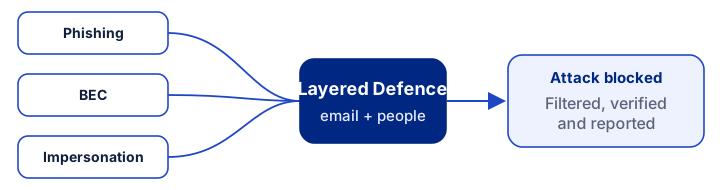
Email is the number-one entry point for cyberattacks, and the most damaging attacks are now highly targeted. This guide explains phishing and Business Email Compromise (BEC), and how to defend against both.
Phishing tricks people into revealing credentials or opening malicious content. Business Email Compromise goes further: a criminal impersonates an executive, supplier, or partner to trick staff into transferring money or data — often with no malware at all, which is why it slips past basic filters.
📑 ON THIS PAGE
Why These Attacks Succeed
They exploit trust and urgency rather than technology. A convincing message that appears to come from your CEO, asking finance to make an urgent payment, bypasses technical defences by targeting a person. As these attacks have become more targeted and better researched, generic spam filters can no longer keep up.
Email Security Benchmark
85% of Security Incidents: Involve human-layer social engineering, with Business Email Compromise (BEC) accounting for over $2.7 billion in global annual losses (Verizon DBIR & FBI IC3 Report).
Technical Defences
- Dedicated email security: anti-phishing and impersonation protection that analyses sender reputation, look-alike domains, and display-name fraud — far beyond built-in filtering.
- Attachment sandboxing and link protection: detonate attachments safely and re-check links at click-time.
- Email authentication (SPF, DKIM, DMARC): lock down your domain so criminals cannot send mail that appears to come from you.
- Multi-factor authentication: MFA so a stolen password alone cannot compromise an account.
- Endpoint protection: EDR to catch anything that does get through and executes.
The Human Layer
Technology cannot stop every attack that targets people, so your staff are a vital line of defence. Regular awareness — teaching people to pause on unexpected payment or data requests, verify through a second channel, and report suspicious messages — turns employees from the weakest link into an early-warning system.
What to Do If You Are Targeted
If a BEC attempt is spotted, do not act on the request; verify it directly with the supposed sender through a known, separate channel, and report it. If a payment has already been made, contact your bank immediately — speed is critical. Treat any credential entered on a suspicious page as compromised and reset it at once.
The Main Types of Phishing Attacks
- Mass phishing: generic messages sent in bulk, hoping a few recipients take the bait.
- Spear phishing: targeted messages tailored to a specific person using researched details, making them far more convincing.
- Whaling: spear phishing aimed at senior executives, whose access and authority make them high-value targets.
- Business Email Compromise: impersonation of a trusted party to authorise fraudulent payments or data release, often with no malicious link or attachment at all.
Anatomy of a BEC Attack
A typical Business Email Compromise unfolds in stages. The attacker first researches the organisation — its people, suppliers, and payment processes — often using public information. They then either spoof a trusted sender or compromise a real mailbox, and send a message that creates urgency: a supplier's bank details have "changed," or an executive needs an "urgent" payment made quietly.
Because the request looks legitimate and pressures the recipient to act fast, it bypasses technical controls by targeting human judgement. Recognising this pattern — urgency, a change to payment details, a request to bypass normal process — is one of the most effective defences.
Building a Security-Aware Culture
Technology and training work best together. Beyond one-off sessions, the goal is a culture where staff feel comfortable pausing on an unexpected request, verifying through a second channel, and reporting anything suspicious without fear of blame. Simple, well-understood rules — such as always confirming any change to payment details by phone using a known number — stop a large share of BEC attempts.
When employees understand that they are a valued line of defence, they become an early-warning system that no filter can replace.
Layering Email Security With the Rest of Your Defences
Email security is most effective as part of a layered posture. If a malicious link or attachment does get through and is opened, endpoint detection and response can catch the resulting activity; if credentials are stolen, multi-factor authentication limits the damage; and consistent protection across email, web, and network closes the gaps attackers probe for. No single layer is perfect, which is precisely why layering works.
The Business Impact of Email Fraud
The consequences of a successful phishing or BEC attack reach well beyond the immediate loss. A fraudulent payment may be unrecoverable; stolen credentials can open the door to a wider breach; and the exposure of personal data brings obligations under Egypt's Personal Data Protection Law.
There is also a quieter cost — the erosion of trust with customers and partners who expect their communications and data to be handled securely. Weighed against these, the investment in dedicated email defences and staff awareness is modest.
How to Spot a Phishing Email
While attacks grow more sophisticated, most phishing messages still share tell-tale signs. Teaching your team to pause and check for these is one of the most effective defences:
- Urgency and pressure: demands to act immediately, before you have time to think.
- Unexpected requests: especially involving payments, bank-detail changes, or credentials.
- Mismatched sender details: a display name that does not match the actual email address, or a look-alike domain.
- Generic greetings and subtle errors: odd phrasing or small inconsistencies.
- Links that do not match: a link whose real destination differs from the text shown.
The single most reliable habit is to verify any unexpected or high-stakes request through a separate, known channel before acting — a quick phone call to a known number defeats most BEC attempts.
Real-World BEC Scenarios
Business Email Compromise takes a few recurring forms. In CEO fraud, a message appearing to come from a senior executive pressures finance into an urgent, confidential transfer. In supplier invoice fraud, an attacker impersonates a real supplier to claim their bank details have changed, diverting a legitimate payment. In payroll diversion, a message posing as an employee requests a change to their salary account.
All three exploit trusted relationships and normal business processes rather than any technical flaw — which is why a simple, enforced rule to verify payment or bank-detail changes out-of-band stops them so effectively.
Testing Your Defences With Simulations
Awareness is not a one-time event. Many organisations run periodic phishing simulations — safe, controlled test emails — to measure how staff respond and reinforce good habits over time. Done supportively rather than punitively, these turn awareness from an annual slide deck into a living skill, and give you a real measure of how resilient your people are to the attacks that matter most.
Frequently Asked Questions (FAQs)
What is Business Email Compromise (BEC)? BEC is a scam in which attackers impersonate a trusted person — often an executive or supplier — to trick an employee into transferring money or sensitive data. It relies on deception rather than malware, which makes it hard to detect.
How can I protect my business from phishing? Combine email security that filters phishing and impersonation, multi-factor authentication to limit the damage of stolen credentials, staff awareness training, and clear verification procedures for payments and data requests.
Why is BEC so dangerous? Because it uses no malware and exploits trust and process rather than technical flaws, BEC often bypasses traditional defences — and the losses from a single successful attack can be very large.
Stop Phishing and BEC
Add dedicated email security and authentication that catch what built-in filtering misses.
Talk to our email security team