
What is Zero Trust? A Practical Guide for Egyptian Enterprises
QUICK ANSWER
Zero Trust is a security model that assumes no user or device is trustworthy by default, even inside the network. Every access request is continuously verified using identity, device health, and context, and each user is granted only the least privilege needed to do their job.
"Zero Trust" is one of the most talked-about ideas in cybersecurity — and one of the most misunderstood. This guide explains what it really means and how to adopt it practically.
Zero Trust is a security model built on a simple principle: never trust, always verify. Instead of assuming everything inside the corporate network is safe, every user and device is verified before being granted access — and only to what they specifically need.
📑 ON THIS PAGE
Why the Old Model Broke
Traditional security trusted anything inside the network perimeter. But remote work, cloud applications, and modern attacks have erased that perimeter. When staff work from anywhere and applications live in the cloud, "inside the network" no longer means "safe" — and once an attacker gets in, a trusting, flat network lets them move freely.
The Core Principles
Zero Trust Impact Benchmark
50% Reduction in Breach Impact: Enterprises implementing Zero Trust Network Access (ZTNA) and identity segmentation reduce average security incident costs by half while accelerating remote workforce onboarding (Forrester Research).
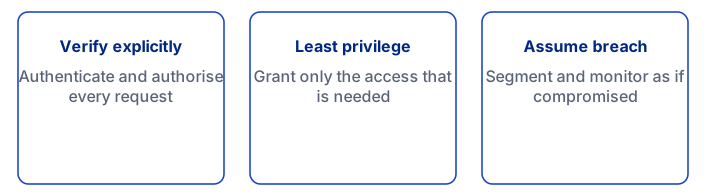
- Verify explicitly: authenticate every access request based on user identity and device health.
- Least-privilege access: grant only the minimum access needed, and nothing more.
- Assume breach: design as if attackers are already inside, and limit how far they can move.
The First Step: Replace the VPN with ZTNA
For most organisations, the highest-value starting point is replacing the legacy VPN. A VPN gives a connected device broad access to the whole network; Zero Trust Network Access (ZTNA) grants access only to specific approved applications, which are never exposed to the open internet. Our guide on ZTNA vs VPN covers this in detail, and our Zero Trust solutions page explains how we deliver it.
The Pillars of a Full Zero Trust Programme
Beyond ZTNA, a complete programme applies verification across several pillars: identity (strong authentication and access management), devices (only healthy devices connect), networks (segmentation via your firewall), applications (per-app access), and data (classified and protected wherever it moves).
How to Start
Zero Trust is a journey, not a product you install overnight. Begin where the risk-to-effort ratio is best — replacing VPN access and strengthening identity — then extend to device posture, segmentation, and data controls in stages. Each phase improves security on its own, so you get value continuously rather than waiting for a single, disruptive rollout.
A Common Misconception: Zero Trust Is Not a Product
One of the biggest misunderstandings is that Zero Trust is something you buy. It is not — it is a security model, an approach that several technologies work together to deliver. No single vendor can sell you "Zero Trust" in a box.
This matters because it changes how you plan: rather than making one purchase, you assess where you stand against the model's principles and close the gaps in a sensible order, using tools that often integrate with what you already own.
The Lateral Movement Problem It Solves
To see why Zero Trust matters, consider how a typical breach spreads. An attacker compromises one device — perhaps through a phishing email — and then moves sideways across a trusting internal network to find and attack more valuable systems.
This "lateral movement" is how a single victim becomes an enterprise-wide incident. Zero Trust breaks the chain: because each user and device can only reach the specific resources they are explicitly granted, a compromised device has nowhere to move.
Containing that spread is one of the model's most valuable practical benefits.
Zero Trust and Compliance
Beyond stopping attacks, Zero Trust supports the compliance obligations Egyptian organisations increasingly face. Its emphasis on least-privilege access, continuous verification, and detailed logging produces exactly the kind of control and evidence expected under frameworks such as Central Bank of Egypt cybersecurity requirements and Egypt's Personal Data Protection Law. In other words, a well-implemented Zero Trust programme improves both your security posture and your ability to demonstrate it.
Measuring Your Progress
Because Zero Trust is a journey, it helps to know where you are on it. A practical way to gauge maturity is to ask, for each pillar: are we still granting broad, standing access, or verifying explicitly and granting the least privilege needed?
Have we replaced flat network access with per-application access? Do we check device health before granting access? Honest answers reveal your next priority — and let you show steady, measurable improvement over time rather than chasing an all-or-nothing ideal.
Zero Trust for Remote and Hybrid Work
Nothing has driven Zero Trust adoption more than the shift to remote and hybrid working. When staff connect from home networks and personal locations, and reach applications in the cloud, the assumptions behind the old perimeter simply do not hold.
Zero Trust fits this reality naturally: it verifies the user and the device on every connection and grants access only to the specific applications needed, so people can work securely from anywhere without exposing the whole network.
For Egyptian organisations supporting flexible work, this is often the most immediate and tangible benefit.
Where Zero Trust Came From
Zero Trust is not a passing trend. The concept was formalised by industry analysts over a decade ago, in response to a clear pattern: again and again, attackers who breached the perimeter found a soft, trusting interior they could move through freely.
It was later developed into formal guidance by bodies such as the US National Institute of Standards and Technology (NIST), whose Zero Trust Architecture guidance is now a widely referenced standard.
This history matters because it shows Zero Trust is a mature, well-established security model — not a marketing label — grounded in hard lessons about how real breaches spread.
Common Zero Trust Myths
Myth: “It is a product you buy” — Zero Trust is an architectural model delivered by several technologies working together.
Myth: “It means trusting nothing, so nothing works” — It means verifying rather than blindly trusting; legitimate users still get smooth access.
Myth: “It is only for large enterprises” — Organisations of any size benefit, and can adopt it in affordable stages.
Myth: “It replaces all existing security” — It builds on and strengthens what you already have, rather than discarding it.
Zero Trust and the Cloud
Zero Trust and cloud adoption go hand in hand. As applications and data move to the cloud, there is no traditional network perimeter to defend — access decisions have to be based on verified identity and device health instead. This makes Zero Trust the natural security model for cloud and hybrid environments, extending consistent, per-application access control across everything an organisation uses, wherever it is hosted.
For Egyptian enterprises modernising their IT, adopting cloud security and Zero Trust are effectively two sides of the same effort.
Frequently Asked Questions (FAQs)
What is Zero Trust security? Zero Trust is a security model based on 'never trust, always verify.' Instead of trusting anything inside the network by default, it continuously verifies every user, device and request before granting access to each resource.
What are the core principles of Zero Trust? Verify explicitly (authenticate and authorise every request), use least-privilege access (grant only what is needed), and assume breach (segment and monitor as if attackers are already inside).
How do you start implementing Zero Trust? Start with strong identity and multi-factor authentication, then add least-privilege access, device verification, network segmentation and Zero Trust Network Access (ZTNA) in phases, rather than all at once.
Start Your Zero Trust Journey
Get a practical, phased Zero Trust plan that fits your environment.
Talk to our Zero Trust specialists