
Healthcare IT Security & Data Protection in Egypt
QUICK ANSWER
Healthcare IT security in Egypt protects patient data and life-critical systems such as electronic records and connected medical devices. WASS Technologies secures hospitals, clinics, and labs with endpoint protection, network segmentation, backup, and access controls, aligned with Egypt's Personal Data Protection Law (Law 151 of 2020).
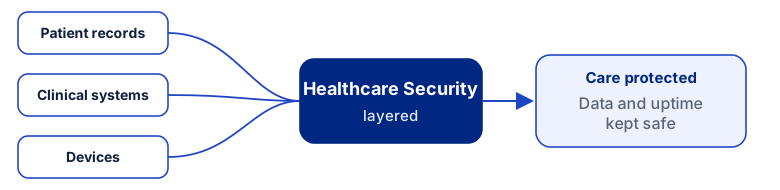
WASS Technologies helps Egyptian hospitals, clinics, and healthcare providers protect patient data and keep life-critical systems available, in line with Egypt's Personal Data Protection Law.
Healthcare is a uniquely high-stakes sector for cybersecurity.
A breach exposes deeply sensitive patient data, and an outage can affect patient care directly. Attackers know this, which is why hospitals worldwide — and increasingly in Egypt — are prime ransomware targets.
Key Cyber Threats Facing Healthcare Providers
- Ransomware: can lock clinical and administrative systems, disrupting patient care.
- Patient-data theft: medical records are highly sensitive and valuable to attackers.
- Legacy and medical systems: older, hard-to-patch equipment expands the attack surface.
- Phishing: targets busy clinical and administrative staff as an entry point.
- Availability risks: downtime of life-critical systems carries real-world consequences.
Healthcare Sector Benchmark
$9.77 Million Average Breach Cost: Healthcare data breaches incur the highest industry recovery costs globally due to strict patient data regulations, EHR sensitivity, and life-critical operational dependencies (IBM Cost of a Data Breach).
Protecting Patient Data Under Egypt's PDPL
In Egypt, patient information is personal data governed by the Personal Data Protection Law (PDPL, Law 151 of 2020). Healthcare providers are responsible for protecting it against loss, unauthorised access, and breach. We help you apply concrete controls — access management, encryption, data loss prevention, reliable recovery — that support these obligations rather than relying on vague assurances.
The Security Stack We Deploy for Healthcare
- Data protection: Data Loss Prevention and encryption to safeguard electronic health records.
- Email security: anti-phishing protection to close the most common attack route.
- Endpoint protection: EDR to detect and stop ransomware on clinical and administrative devices.
- Segmentation: firewall and network segmentation to isolate and protect legacy medical systems.
- Resilience: immutable backup and disaster recovery so patient care can continue after an incident.
Why Healthcare Providers Choose WASS Technologies
We understand that in healthcare, availability and confidentiality are not competing priorities — both are essential. We design layered protection that keeps patient data private and clinical systems running, mapped to Egypt's PDPL, supported by a local team that can respond quickly when it matters most.
Balancing Availability and Confidentiality
Healthcare security carries a tension found in few other sectors: clinical systems must be both tightly protected and instantly available, because a control that locks a doctor out of a patient record at the wrong moment can be as harmful as a breach. We design controls with this balance in mind — strong protection that does not obstruct care — so security supports clinicians rather than fighting them.
Securing Connected and Legacy Medical Systems
Hospitals run a mix of modern connected devices and older systems that cannot easily be patched or replaced.
Both expand the attack surface. Because many of these systems cannot host security software directly, we protect them through network segmentation and monitoring — isolating them from general traffic so that a compromise elsewhere cannot reach critical clinical equipment, and watching for unusual activity around them.
Incident Response for Healthcare
When a healthcare provider is attacked, speed is everything — every hour of downtime can affect patient care. Our Managed Detection & Response service provides round-the-clock monitoring and rapid containment, and our recovery planning ensures that if systems are hit, they can be restored quickly from clean, immutable backups rather than leaving clinicians without their tools.
Building Cyber Resilience in Healthcare
Resilience means assuming an incident will eventually happen and being ready to recover with minimal disruption. We help healthcare organisations build that resilience through tested disaster recovery, staff awareness against phishing, and a layered posture that keeps both patient data and patient care protected.
Compliance Evidence and Audit Readiness
Meeting Egypt’s PDPL requires both technical controls and auditable proof of compliance.
We help healthcare providers maintain access logs, documented incident handling, and tested disaster recovery to eliminate the risk of penalties and protect patient trust.
Frequently Asked Questions (FAQs)
Why is healthcare a major target for cyberattacks? Healthcare organisations hold highly sensitive patient data and run systems that are literally life-critical, which makes them attractive to attackers — ransomware against a hospital creates enormous pressure to pay quickly.
How is patient data regulated in Egypt? Patient data is personal data under Egypt's Personal Data Protection Law (PDPL, Law 151 of 2020), which governs how it must be protected, stored, and handled. We help healthcare providers apply the right controls.
How do you protect hospitals from ransomware? With layered defence: endpoint detection and response, email security to block the main delivery route, network segmentation to protect medical systems, and immutable backups with tested recovery so care can continue without paying a ransom.
Can you protect electronic health records (EHR)? Yes. We secure the systems that store patient records with access controls, data loss prevention, encryption, and reliable backup and recovery, aligned with Egypt's PDPL.
Do you secure legacy medical systems? Yes. Older medical and administrative systems often cannot be patched easily, so we protect them with network segmentation and monitoring to reduce their exposure.
Free tool: Start with our PDPL compliance self-assessment.
Protect Patient Data and Care
Secure electronic health records and keep life-critical systems available, aligned with Egypt's PDPL.
Talk to our healthcare security team