
Telecom & ISP Cybersecurity in Egypt
QUICK ANSWER
Telecom cybersecurity in Egypt protects large-scale network infrastructure and subscriber data against threats that can disrupt service for millions. WASS Technologies secures operators and ISPs with network security, SIEM-based monitoring, and resilient architecture, aligned with NTRA rules and Egypt's Personal Data Protection Law.
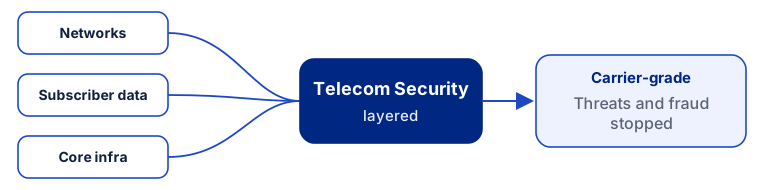
WASS Technologies helps Egyptian telecom operators and internet service providers secure large-scale network infrastructure and protect subscriber data, aligned with NTRA obligations and the PDPL.
Telecom operators run some of the largest, most always-on infrastructure in the country and hold enormous volumes of subscriber data. An outage or breach affects not just the operator but the customers and businesses that depend on connectivity — making resilience and security a regulatory and commercial imperative.
Key Cyber Threats Facing Telecom Operators
- DDoS attacks: attempts to overwhelm and disrupt network services.
- Network infrastructure attacks: targeting the core systems that carry traffic.
- Subscriber-data breaches: theft of large volumes of personal and account data.
- Availability risks: disruptions with wide impact across customers and businesses.
- Insider and third-party risk: misuse of access to critical network systems.
Telecom DDoS Benchmark
40% Surge in Volumetric DDoS: Global attacks exceeding 1 Tbps increased by 40% year-over-year, targeting ISP DNS resolvers and core carrier routing boundaries (Cloudflare Telecom Threat Report).
Regulatory Requirements: NTRA and PDPL
Telecom operators and ISPs in Egypt work under the oversight of the National Telecom Regulatory Authority (NTRA) and must protect subscriber personal data under Egypt's Personal Data Protection Law (PDPL, Law 151 of 2020). This demands strong network security, continuous monitoring, and demonstrable data-protection controls across a very large environment.
The Security Stack We Deploy for Telecom
- Network security: next-generation firewalls and segmentation to protect and isolate critical network systems.
- Monitoring & detection: SIEM for large-scale correlation, backed by 24/7 Managed Detection & Response.
- Resilient infrastructure: secure enterprise infrastructure and disaster recovery for always-on services.
- Data protection: Data Loss Prevention and access controls to safeguard subscriber data.
Why Telecom Operators Choose WASS Technologies
We bring vendor-certified expertise in large-scale network security and monitoring, combined with an understanding of NTRA and PDPL obligations. We help operators protect always-on infrastructure and subscriber data, detect and contain attacks quickly, and demonstrate the controls their regulators expect — all with local support in Cairo.
Protecting Always-On Infrastructure
Telecom networks cannot simply be taken offline for maintenance or after an incident — customers, businesses, and other critical services depend on constant availability.
This changes how security must be designed: controls have to protect the network without interrupting it, and recovery has to happen with minimal disruption. We build security and resilience into the infrastructure itself, so protection and uptime reinforce each other rather than compete.
Securing Subscriber Data at Scale
Operators hold personal and account data for enormous numbers of subscribers, making them high-value targets and placing them squarely under Egypt's Personal Data Protection Law. Protecting data at this scale requires strong access controls over who can reach subscriber systems, data loss prevention to stop bulk exfiltration, and monitoring to detect misuse early — controls we design to work across very large environments.
DDoS and Network-Layer Resilience
Distributed denial-of-service attacks are a constant reality for telecom operators, aimed at overwhelming services and cutting off connectivity. We help operators build resilience through network security, segmentation that contains attacks, and continuous monitoring that identifies and responds to volumetric and infrastructure attacks quickly, keeping services available.
Monitoring a Large-Scale Environment
The sheer size of a telecom environment makes visibility a challenge — threats can hide in enormous volumes of network activity. Our SIEM and managed detection and response services correlate signals across the environment and provide the round-the-clock analyst attention needed to find and contain threats that automated tools alone would miss.
Business Continuity for Critical Connectivity
Because so much depends on telecom services, operators need robust business continuity — the ability to keep services running and recover quickly from any disruption, whether an attack, a hardware failure, or a disaster. We design resilient architectures and tested disaster recovery so that critical connectivity is maintained and restored rapidly, protecting both the operator and the many customers and services that rely on it.
Frequently Asked Questions (FAQs)
What cybersecurity do telecom operators in Egypt need? Telecom and ISP operators need to protect large, always-on networks and vast amounts of subscriber data: DDoS-resilient network security, continuous monitoring and detection, and strong data protection — aligned with NTRA obligations and the PDPL.
Who regulates telecom security in Egypt? Telecom operators and ISPs in Egypt operate under the National Telecom Regulatory Authority (NTRA), and must also protect subscriber personal data under the PDPL (Law 151 of 2020).
How do you protect against DDoS and network attacks? We deploy network security, segmentation, continuous monitoring through SIEM, and managed detection and response to identify and contain attacks against network infrastructure quickly.
Can you protect subscriber data? Yes. We apply data protection, access control, and monitoring so subscriber personal data is safeguarded in line with the PDPL and NTRA expectations.
Do you provide 24/7 monitoring for telecom infrastructure? Yes. Our Managed Detection and Response service provides continuous monitoring and response for always-on network environments from an Egypt-based SOC.
Secure Your Network and Subscribers
Protect large-scale telecom infrastructure and subscriber data, aligned with NTRA and the PDPL.
Talk to our telecom security team