
Cybersecurity for Banks & Financial Services in Egypt
QUICK ANSWER
Cybersecurity for banks in Egypt requires layered protection for financial data and transactions, aligned with Central Bank of Egypt (CBE) requirements and the Personal Data Protection Law. WASS Technologies delivers this with network security, EDR and MDR, data loss prevention, and identity controls tailored to Egyptian financial institutions.
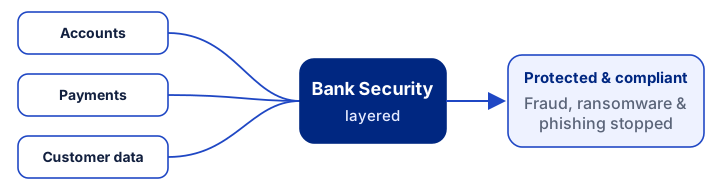
WASS Technologies helps Egyptian banks, fintechs, and financial institutions build layered cybersecurity that protects customer funds and data, and meets Central Bank of Egypt expectations.
Financial services are the most targeted sector in Egypt. Banks hold money and sensitive customer data, run systems that cannot go down, and operate under some of the country's strictest regulatory oversight. That combination demands a security posture built in depth, not a single product.
Key Cyber Threats Facing Egyptian Banks
- Ransomware: capable of halting core banking and payment systems, with direct revenue and reputational impact.
- Fraud and Business Email Compromise: targeted attacks that trick staff or customers into fraudulent transfers.
- Data breaches: theft of customer financial and personal data.
- Insider threats: misuse of privileged access to sensitive systems.
- DDoS and availability attacks: attempts to take online and mobile banking offline.
Financial Compliance Benchmark
CBE Regulatory Framework: Central Bank of Egypt regulations mandate 24/7 continuous SOC monitoring, multi-factor authentication across all privileged sessions, and annual third-party VAPT audits across all financial institutions.
Regulatory Requirements: CBE and PDPL
Egyptian financial institutions operate under the cybersecurity and data-resilience expectations of the Central Bank of Egypt (CBE), and must protect customer personal data under Egypt's Personal Data Protection Law (PDPL, Law 151 of 2020). In practice this means demonstrable controls, continuous monitoring, tested recovery, and a clear audit trail — not just security tools, but evidence they work.
The Security Stack We Deploy for Financial Services
- Network security: next-generation firewalls with segmentation to isolate card-processing and core banking systems.
- Endpoint & managed detection: EDR plus 24/7 Managed Detection & Response from an Egypt-based SOC.
- Monitoring & audit: SIEM for correlation, alerting, and audit-ready reporting.
- Data protection: Data Loss Prevention and email security to stop leakage and phishing.
- Resilience: immutable backup and tested disaster recovery to meet strict RTO/RPO.
- Identity: Identity & Access Management to control and audit privileged access.
Why Egyptian Banks Choose WASS Technologies
We combine vendor-certified expertise across the leading security platforms with deep familiarity with the Egyptian regulatory environment. We design controls that map to CBE expectations and PDPL, deliver the continuous monitoring regulators increasingly require, and prove that critical systems can be recovered — all coordinated by a local team across Egypt.
Why Layered Defence Matters in Banking
No single product secures a bank. Attackers probe every layer — the network perimeter, employee inboxes, endpoints, privileged accounts, and backups — so defence has to be built in depth, with each layer catching what the others miss.
A phishing email that gets past the gateway should still be caught on the endpoint; an intrusion that evades the endpoint should still be visible in the SIEM; and if all else fails, immutable backups and tested recovery keep the institution operating.
This defence-in-depth approach is the core of how we design security for financial institutions.
Third-Party and Supply-Chain Risk
Modern banks depend on a web of fintech partners, payment processors, and technology vendors. Each connection is a potential entry point, and attackers increasingly target the weakest supplier to reach a well-defended bank. We help financial institutions extend their security posture to these relationships — through segmentation, strict access control for third parties, and monitoring of the connections that partners use.
24/7 Monitoring and Incident Response
For a bank, the difference between a contained event and a headline breach is often measured in minutes. That is why continuous monitoring and a ready incident-response capability are essential. Our Managed Detection & Response service watches your environment around the clock and moves immediately to contain confirmed threats, while SIEM provides the correlation and audit trail that both investigations and regulators require.
Building a Security Roadmap
Strong banking security is built in stages, not bought in a single purchase. We help institutions assess their current posture, prioritise the gaps that carry the most risk, and deliver improvements in a sequenced roadmap — so security matures steadily and every investment is justified against real threats and regulatory expectations.
Protecting Digital and Mobile Banking Channels
Online and mobile banking have become the primary way customers interact with their bank — and a primary target for attackers seeking fraud, account takeover, and service disruption. We help institutions protect these customer-facing channels with web and application security, strong authentication through multi-factor authentication, and monitoring for fraudulent activity, so the convenience of digital banking does not come at the cost of customer trust.
Frequently Asked Questions (FAQs)
What cybersecurity do Egyptian banks need? Egyptian banks need layered protection: next-generation firewalls, EDR and 24/7 managed detection and response, SIEM for monitoring and audit, data loss prevention, immutable backup and disaster recovery, and strong identity and access controls aligned with Central Bank of Egypt expectations.
Does the Central Bank of Egypt require cybersecurity controls? Yes. The Central Bank of Egypt sets cybersecurity and data-resilience expectations for banks and financial institutions. We design controls, monitoring, and recovery capabilities that help institutions meet these obligations.
How do you protect banks against ransomware? With a layered approach: endpoint detection and response, email and web security to block the delivery routes, network segmentation, and — critically — immutable backups and tested disaster recovery so operations can be restored without paying a ransom.
Can you provide 24/7 monitoring for a bank? Yes. Our Managed Detection and Response service provides round-the-clock monitoring and response from an Egypt-based SOC, which is increasingly expected of regulated financial institutions.
Do you help with regulatory audits and reporting? Yes. SIEM-based monitoring, documented incident handling, and access governance produce the evidence auditors and the Central Bank of Egypt expect.
Free tool: Assess your posture with our PDPL compliance checklist.
Secure Your Financial Institution
Build layered, audit-ready cybersecurity aligned with Central Bank of Egypt expectations.
Talk to our financial-sector security team