
EDR vs Antivirus: What's the Difference?
QUICK ANSWER
Antivirus blocks known malware by matching signatures, while EDR (Endpoint Detection and Response) continuously records endpoint activity to detect, investigate, and respond to threats antivirus misses, including fileless and zero-day attacks. Antivirus prevents; EDR adds detection, threat hunting, and response for modern threats.
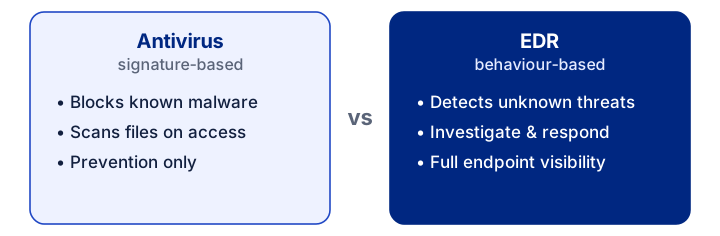
Traditional antivirus and Endpoint Detection and Response (EDR) both protect your devices, but they work in fundamentally different ways. This guide explains the difference and which your organisation needs.
For years, antivirus was enough. It compared files against a list of known malware signatures and blocked matches. But modern attacks — fileless malware, ransomware, and living-off-the-land techniques — are built specifically to slip past signature checks. That gap is what EDR was created to close.
At a Glance: EDR vs Antivirus
| Traditional Antivirus | EDR (Endpoint Detection & Response) | |
|---|---|---|
| Approach | Signature-based — blocks known malware | Behaviour-based — detects suspicious activity |
| Unknown / zero-day threats | Limited coverage | Strong coverage |
| Fileless & in-memory attacks | Often missed | Detected |
| Visibility | Minimal | Full endpoint telemetry, recorded |
| Response | Block or quarantine | Investigate, isolate, and roll back |
| Best for | Baseline prevention | Detection, investigation & response |
Detection Benchmark
99%+ Zero-Day Detection: Behavioral EDR catches over 99% of fileless and evasive ransomware variants, compared to traditional signature antivirus which misses up to 70% of polymorphic zero-day exploits (AV-TEST Institute).
What Traditional Antivirus Does
Antivirus (now often called Endpoint Protection, or EPP) is preventive. It scans files and blocks anything matching a known-bad signature or simple heuristic. It is fast, low-overhead, and effective against the large volume of commodity malware — but by design it struggles with threats it has never seen before.
What EDR Adds
EDR assumes some threats will get past prevention. It continuously records what is happening on every endpoint — processes, network connections, file changes — and analyses that behaviour for signs of an attack. When it finds something, it does not just block; it lets you investigate the full chain of events, isolate the affected machine, and remediate.
Crucially, most EDR platforms include next-generation antivirus as their prevention layer, so EDR is a superset, not a replacement you bolt on beside your old antivirus.
Which Should You Choose?
- You have only legacy antivirus: you are protected against known malware but blind to modern, targeted attacks — the most common cause of serious breaches today.
- You want real protection against ransomware and unknown threats: you need EDR, which includes prevention and adds detection and response.
- You do not have a 24/7 security team: choose EDR delivered as a managed service — see Managed Detection & Response (MDR) — so the alerts EDR generates are actually investigated around the clock.
How WASS Technologies Helps
We deploy EDR and next-generation antivirus/endpoint protection for Egyptian enterprises using platforms such as Sophos Intercept X, Kaspersky, and ESET, and we can wrap them in MDR so detection turns into response. We help you move from signature-only antivirus to a modern endpoint posture without disrupting your users.
Why Signatures Alone No Longer Work
Signature-based antivirus works by recognising malware it has seen before. That model held up when new malware was relatively rare and slow to spread.
Today, attackers automatically generate unique malware variants at massive scale, and many attacks use no malware file at all — instead abusing legitimate tools already on the system, a technique known as "living off the land." A defence that only recognises known-bad files is structurally unable to catch these.
The Role of AI and Behavioural Analysis
This is where behaviour-based detection changes the game. Instead of asking "have I seen this exact file before?", EDR asks "is this activity behaving like an attack?" Using machine learning and behavioural analysis, it can flag a trusted program suddenly encrypting files, a script reaching out to a command-and-control server, or an unusual chain of processes — even when no known malware is involved.
That behavioural lens is what lets EDR catch the novel and fileless threats signatures miss.
EPP, EDR, XDR, and MDR: How They Fit Together
These acronyms describe layers of the same story. EPP (Endpoint Protection Platform) is modern antivirus — prevention. EDR adds detection and response on the endpoint. XDR extends that detection across email, network, and cloud, not just endpoints. MDR is the managed service that operates these tools for you.
Most organisations do not choose between them in isolation — they build up through them, and the right starting point depends on your team and your risk.
Migrating from Antivirus to EDR Without Disruption
Replacing endpoint protection sounds risky, but done properly it is smooth. We assess your current estate, deploy the new EDR agent during a transition window, migrate your policies, validate against your real traffic, and then retire the legacy antivirus. Users typically notice nothing except better performance, since modern EDR agents are lighter than the bloated antivirus suites they replace.
Frequently Asked Questions (FAQs)
Is EDR the same as antivirus? No. Antivirus focuses on preventing known malware using signatures, while EDR continuously watches endpoint behaviour to detect, investigate, and respond to threats — including unknown and fileless attacks that antivirus misses.
Do I still need antivirus if I have EDR? In practice you get both: most modern EDR platforms include next-generation antivirus (prevention) as their first layer, then add detection and response on top. You do not run a separate legacy antivirus alongside it.
Which is better for a small business? A small business with no security team may start with strong endpoint protection (next-gen antivirus), but even small organisations increasingly need EDR — often delivered as a managed service — because ransomware now targets companies of every size.
Can EDR stop ransomware that antivirus misses? Yes. Because EDR watches behaviour rather than only signatures, it can spot the encryption activity of a brand-new ransomware strain and, on many platforms, roll affected files back to a safe state.
How do I move from antivirus to EDR? We assess your current endpoints, deploy an EDR platform such as Sophos Intercept X or Kaspersky, migrate your policies, and can layer on managed detection and response so the alerts are actually acted upon.
Not Sure Which You Need?
Get an honest assessment of your endpoint protection and a clear recommendation.
Talk to our endpoint security team across Egypt