
SIEM vs SOAR vs XDR: What's the Difference?
QUICK ANSWER
SIEM collects and correlates logs from across your environment to detect threats; SOAR automates and orchestrates the response to those alerts; XDR unifies detection and response across endpoints, network, email, and cloud in one platform. They are complementary layers, not competitors — mature security programmes often use all three.
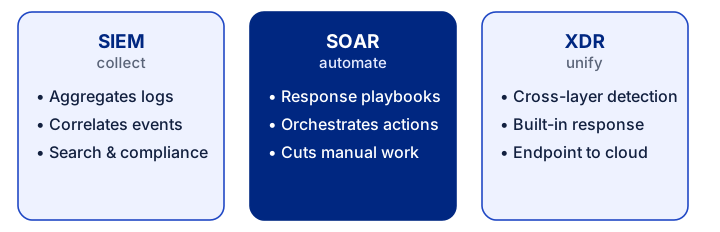
SIEM, SOAR, and XDR are three of the most talked-about acronyms in enterprise security — and three of the most frequently confused. They overlap, they integrate, and vendors often blur the lines between them. But each solves a distinct problem, and understanding the difference helps you invest in the right capability for where your organisation actually is today.
📑 ON THIS PAGE
What Is SIEM?
SIEM — Security Information and Event Management — is the foundation of most security operations. It collects logs and events from across your environment (servers, endpoints, firewalls, and cloud services), normalises them into a common format, and correlates them to surface suspicious patterns that no single system would reveal on its own. It provides a central console, real-time alerting, and the long-term data retention needed for investigations and compliance.
Its great strength is visibility; its limitation is that it produces alerts, not actions — a human still has to investigate and respond. You can read more in our overview of SIEM and security analytics.
What Is SOAR?
SOAR — Security Orchestration, Automation and Response — picks up where SIEM leaves off. It connects your security tools together and runs playbooks that automate repetitive response steps: enriching an alert with threat intelligence, isolating a compromised endpoint, disabling a user account, or opening a ticket, all without waiting for manual intervention.
The result is less analyst fatigue and dramatically faster response times. SOAR does not detect threats itself; it acts on what other tools detect, making a busy security team more consistent and efficient.
What Is XDR?
XDR — Extended Detection and Response — is the newest of the three and takes a different approach. Where EDR focuses on endpoints, XDR unifies detection and response across multiple layers — endpoint, network, email, identity, and cloud — inside a single platform with shared analytics.
Because the correlation is built in rather than assembled from separate products, XDR aims to deliver faster, higher-fidelity detection with less engineering effort. It is closely tied to the AI-driven detection that increasingly powers modern security tooling.
SIEM vs SOAR vs XDR at a Glance
SecOps Efficiency Benchmark
70% Faster Alert Investigation: Combining SIEM log aggregation with automated SOAR playbooks and XDR endpoint telemetry reduces analyst alert fatigue and accelerates investigation cycles by up to 70% (Gartner SOC Visibility Triad).
| SIEM | SOAR | XDR | |
|---|---|---|---|
| Full name | Security Information & Event Management | Security Orchestration, Automation & Response | Extended Detection & Response |
| Primary job | Collect & correlate logs to detect threats | Automate & orchestrate the response | Detect & respond across multiple layers |
| Data scope | Logs from across the whole environment | Actions across connected security tools | Endpoint, network, email, identity & cloud |
| Main strength | Visibility & compliance reporting | Speed & consistency of response | Built-in cross-layer correlation |
| Best for | Central visibility & audit trails | SOC teams drowning in repetitive tasks | Unified detection without stitching tools together |
How the Three Work Together
In a mature security programme, the three reinforce one another. XDR and endpoint tools generate high-quality detections across your systems; the SIEM aggregates those detections alongside logs from everything else, providing both the complete picture and the historical record needed for investigations and compliance; and SOAR automates the routine response actions so analysts can focus on genuine decisions.
A human team — a SOC, whether your own or a provider's — sits at the centre, using all three to investigate and contain what matters.
Seen this way, the question is rarely SIEM versus SOAR versus XDR, but how to combine them for your situation.
Which Do You Actually Need?
SIEM, SOAR, and XDR are complementary security technologies that serve distinct roles in enterprise defense.
Most organizations start with endpoint detection and SIEM for visibility, then add SOAR to automate workflows and XDR to unify multi-vector telemetry.
It is also worth being honest about complexity. Each of these platforms takes skill to deploy and tune well; configured poorly, a SIEM drowns a team in false positives, a SOAR playbook automates the wrong action, and an XDR console becomes one more screen nobody watches.
Technology alone does not deliver security outcomes — the people and processes operating it do. That is why, for many Egyptian organisations, the fastest route to real protection is to pair the right tools with a team that already knows how to run them.
That last point is decisive. The most sophisticated platform underdelivers if nobody is watching it at 3am. For organisations without a 24/7 team, the practical answer is often Managed Detection and Response (MDR), which delivers the outcomes of SIEM, SOAR, and XDR — correlation, automation, and expert response — as a service.
If you are still deciding how to run detection and response, our guide on what a SOC is — a useful companion.
Frequently Asked Questions
Is XDR replacing SIEM? Not for most organisations. XDR unifies detection and response across security layers, but SIEM still provides broad log collection and the long-term retention needed for compliance and investigations. Many mature programmes run both, with XDR feeding the SIEM.
What is the difference between SOAR and XDR? SOAR automates and orchestrates response across your existing, separate tools; XDR is a single platform that builds detection and response across layers in from the start. SOAR integrates what you already have; XDR replaces several point tools with one.
Do I need all three of SIEM, SOAR, and XDR? Not necessarily. Smaller teams often start with strong endpoint detection and a SIEM, then add SOAR or move toward XDR as they mature. The right mix depends on your size, in-house skills, and whether you run detection and response yourself or through a managed service.
Which is best for a business in Egypt without a security team? If you lack a 24/7 team, the platform matters less than who operates it. A managed detection and response (MDR) service gives you the outcomes of SIEM, SOAR, and XDR — monitoring, correlation, and response — without you having to run the tools yourself.
Related: What Is XDR? · XDR Security
Not Sure Which You Need?
Get vendor-neutral advice on the right detection and response stack for your environment and team.
Talk to our security teamFurther reading: What Is a SOC? · MDR vs EDR · EDR vs Antivirus
