
Enterprise Cloud Security Solutions in Egypt
QUICK ANSWER
Cloud security protects data, applications, and workloads across platforms such as Microsoft 365, AWS, and Azure. WASS Technologies secures Egyptian cloud estates with CASB, cloud workload protection, container security, security posture management, and data loss prevention, aligning configuration and access controls with Egypt's PDPL and industry best practice.
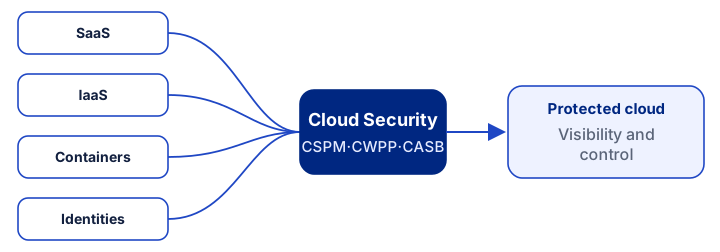
WASS Technologies secures the cloud workloads, applications, and data that Egyptian enterprises depend on, closing the gaps that appear as organisations move to Microsoft 365, AWS, and Azure.
Cloud adoption changes where your data lives, but not who is responsible for protecting it. Under the shared-responsibility model, your cloud provider secures the underlying platform — you remain responsible for your data, identities, configurations, and workloads.
Most cloud breaches are not sophisticated hacks; they come from misconfigured storage, weak identity controls, and unmonitored SaaS usage. Cloud security tools give you visibility and control over your side of that responsibility.
Core Cloud Security Capabilities
- Cloud Workload Protection: Harden and protect servers, virtual machines, and containers running in public and hybrid cloud.
- Cloud Access Security Broker (CASB): Gain visibility and control over how staff use SaaS applications, with data protection and threat detection built in.
- Configuration & Posture Management: Continuously check cloud settings for the misconfigurations that lead to exposed data.
- Identity-Centric Access Control: Enforce least-privilege access and strong authentication, pairing with our Zero Trust and Identity & Access Management services.
- Cloud Data Loss Prevention: Stop sensitive data from leaking through cloud apps and storage.
Securing Microsoft 365, AWS, and Azure
Different platforms need different controls. For Microsoft 365, we strengthen identity, email, and data protection beyond the native tools. For workloads in AWS and Azure, we add workload protection and threat detection for your servers and containers.
The goal is one consistent security posture across on-premises and cloud, rather than a patchwork of disconnected settings that attackers exploit.
Cloud Security Vendors We Deploy
- Sophos Cloud: Cloud workload protection and posture management integrated with Sophos Central.
- Symantec CloudSOC (CASB): Mature cloud access security for visibility and control over SaaS usage.
- Kaspersky Hybrid Cloud Security: Protection for workloads across private and public cloud environments.
Cloud Security and Data Residency for Egyptian Enterprises
For regulated Egyptian organisations, moving to the cloud raises real questions about where data resides and who can access it. We help you apply the right controls, and where necessary keep sensitive data on-premises or in-country, so your cloud strategy aligns with Egypt's Personal Data Protection Law (PDPL) and sector rules such as Central Bank of Egypt requirements for banking data.
This work pairs with our firewall and disaster recovery services for end-to-end resilience.
Cloud Security Posture Management (CSPM)
The leading cause of cloud data exposure is not a clever attack — it is a misconfiguration. A single storage bucket left public or one over-permissive access rule can expose large volumes of records. Cloud Security Posture Management continuously checks your cloud settings against best practice and flags risky configurations before an attacker finds them.
We implement CSPM across your Microsoft 365, AWS, and Azure environments so misconfigurations are caught and corrected as part of normal operations rather than discovered during a breach.
Container and Kubernetes Security
Modern applications increasingly run in containers and Kubernetes, and these workloads need protection built for them: scanning container images for vulnerabilities before deployment, enforcing runtime protection, and controlling what each container is allowed to do. We extend workload protection to containerised environments so security keeps pace with how your teams build.
SaaS Security and Shadow IT
Employees adopt cloud apps faster than IT can track them. This "shadow IT" creates blind spots where sensitive data ends up in unsanctioned services. A Cloud Access Security Broker (CASB) reveals which cloud apps are actually in use, controls how corporate data flows through them, and applies consistent security and data-protection policy across sanctioned SaaS such as Microsoft 365.
Securing Cloud Migrations
The riskiest moment for cloud data is often the migration itself. We build security into cloud-migration projects from the start — identity and access design, network segmentation, encryption, and posture baselines — so you do not inherit misconfigurations or expose data while moving. This complements our infrastructure and disaster recovery work.
Frequently Asked Questions (FAQs)
Isn't my cloud provider responsible for security? Under the shared-responsibility model, the provider secures the cloud infrastructure, but you are responsible for securing your data, identities, configurations, and workloads in it. Cloud security tools cover your side of that responsibility.
What is a CASB and do I need one? A Cloud Access Security Broker gives you visibility and control over how staff use cloud apps like Microsoft 365, including data protection and threat detection. It is valuable once your organisation relies on SaaS applications for sensitive work.
Can you secure workloads in AWS and Azure? Yes. We deploy cloud workload protection for servers and containers running in AWS and Azure, covering hardening, threat detection, and response for hybrid and multi-cloud environments.
Does cloud security help with data residency? It supports it. We configure controls and, where required, on-premises or in-country hosting options so sensitive data handling aligns with Egypt's Personal Data Protection Law (PDPL) and sector requirements.
How does cloud security fit with my firewall and DLP? It extends them. Cloud security applies the same principles — threat prevention, data protection, and access control — to environments your on-premises firewall cannot see.
What is CSPM and why does it matter? Cloud Security Posture Management continuously checks your cloud settings for misconfigurations — the leading cause of cloud data exposure — and flags risky settings such as public storage or over-permissive access before attackers find them.
Can you secure containers and Kubernetes? Yes. We scan container images for vulnerabilities before deployment and apply runtime protection, extending cloud security to modern containerised workloads.
Related comparison: Backup vs Disaster Recovery
Related solutions: CASB · Secure Web Gateway
Secure Your Cloud Environment
Cloud adoption shifts your risk, not your responsibility. Get visibility and control over your workloads, apps, and data.
Talk to our cloud security team across Egypt