
What Is XDR? A Guide for Egyptian Enterprises
QUICK ANSWER
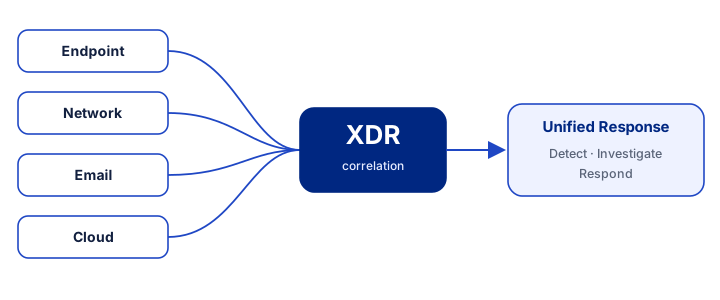
XDR (Extended Detection and Response) is a security platform that collects and automatically correlates threat data from across your environment — endpoints, network, email, servers and cloud — so attacks that move between these layers are detected and investigated as one incident. It is the connected evolution of EDR, and it helps lean security teams respond faster.
What Is XDR? A Guide to Extended Detection and Response
Telemetry Correlation Benchmark
88% Faster Threat Detection: Cross-layer correlation linking endpoint telemetry with cloud email and network logs reduces Mean Time to Detect (MTTD) from weeks to hours (IDC Security Operations Study).
Security teams today are buried in alerts from tools that do not talk to each other. XDR was created to fix that. This guide explains what XDR is, how it works, and how it compares with the tools you may already have — so you can decide whether it belongs in your security strategy.
What XDR Actually Does
Most attacks leave traces in more than one place: a phishing email, a suspicious process on a laptop, an unusual network connection. Traditional tools each see one piece and raise a separate alert, leaving analysts to connect the dots manually — if they ever do.
XDR ingests telemetry from all these layers into one platform and automatically correlates related signals into a single, complete incident with a full attack timeline. Instead of a hundred disconnected alerts, your team sees a handful of clear stories.
How XDR Works
An XDR platform continuously gathers data from endpoints, network sensors, email security, servers and cloud workloads into a common data store. It applies built-in detection logic and analytics to spot malicious patterns, groups related detections into incidents, and provides one console to investigate and respond — isolating a device, blocking a sender or killing a process in a click.
Much of this is automated, which is what makes XDR so valuable to teams short on time.
XDR vs EDR vs SIEM vs MDR
- EDR watches endpoints. XDR extends that same detect-and-respond model across the whole environment.
- SIEM collects and correlates logs from everywhere, but traditionally needs heavy engineering; XDR arrives with detection and response built in, focused on security telemetry.
- MDR is a service — expert analysts operating detection-and-response tools (often XDR) for you around the clock.
For a deeper comparison, see our guide on SIEM vs SOAR vs XDR.
The Benefits of XDR
- Faster detection and response — correlated incidents and automated actions cut mean time to respond.
- Less alert fatigue — many raw alerts collapse into a few meaningful incidents.
- Broader visibility — see attacks that cross endpoint, network and email boundaries.
- More from a lean team — automation lets a small team achieve more.
When Should You Consider XDR?
XDR makes most sense if you already rely on multiple, disconnected security tools; if your team is overwhelmed by alerts; or if you want stronger detection without building a large SIEM operation. If you have no security operations capacity at all, consider XDR delivered with a managed service. WASS helps Egyptian organisations assess where they are and choose the right path.
What XDR Is Not
It helps to clear up common misconceptions. XDR is not simply a rebranded antivirus, nor a single product that replaces every other tool — it is a platform that connects and correlates your detection layers. It is not only for large enterprises; smaller teams often gain the most from its automation.
And it is not a “set and forget” technology — like any detection capability, XDR delivers its best results when tuned to your environment and backed by a clear response process.
XDR in Egypt
For Egyptian enterprises — especially in banking, government and critical infrastructure — XDR offers the connected visibility and documented, rapid response that regulators increasingly expect. WASS Technologies deploys XDR solutions using Sophos, Kaspersky and ESET, with local engineers and support.
How to Evaluate an XDR Platform
If you are considering XDR, a few questions cut to the heart of the decision. Which telemetry does it actually correlate — endpoint only, or also network, email, identity and cloud? How much of the detection and response is automated out of the box, versus requiring you to build it? Does it fit the security tools you already own, or would it mean replacing them?
How steep is the learning curve for your team, and is a managed option available if you lack capacity? And how transparent is its detection — can your analysts understand and trust why it flagged something? Answering these honestly usually points to the right platform for your situation.
WASS helps Egyptian organisations work through this evaluation objectively, drawing on our experience deploying Sophos, Kaspersky and ESET XDR, so the choice is based on fit rather than marketing.
Frequently Asked Questions (FAQs)
Is XDR just marketing for a better EDR? No — EDR is endpoint-only; XDR correlates endpoint, network, email, server and cloud telemetry into single incidents.
Do I need a big team to run XDR? No — XDR reduces effort through automation, so lean teams benefit most; if you have no capacity, pair it with MDR.
Can XDR replace my SIEM? Often yes for mid-sized organisations; large enterprises with broad compliance-logging needs may keep both.
Learn more: XDR Security Solutions · EDR Security · Managed Detection & Response
Is XDR Right for Your Business?
Ask our team across Egypt for a short XDR readiness conversation — we map your current tools and show where XDR would close the biggest gaps.
Talk to our team across Egypt