
MDR vs EDR: Which Do You Need?
QUICK ANSWER
EDR is the technology that detects and responds to endpoint threats; MDR (Managed Detection and Response) is a service that adds a 24/7 team of security analysts to operate that technology for you. Choose EDR if you already run a security team; choose MDR if you do not.
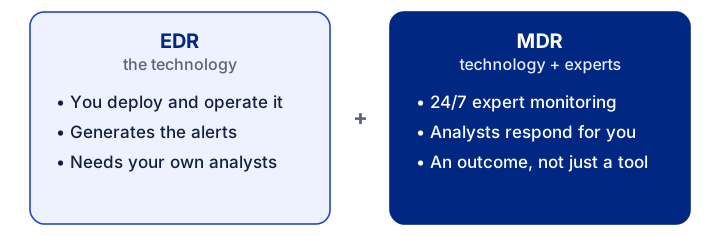
EDR and MDR are often confused, but one is a technology and the other is a service. Understanding the difference tells you whether you need a tool, a team, or both.
Buying EDR gives you a powerful detection tool — but a tool still needs someone to operate it. That is the distinction at the heart of this comparison: EDR is what detects the threat; MDR is who investigates and responds to it.
At a Glance: MDR vs EDR
| EDR | MDR | |
|---|---|---|
| What it is | A technology / tool | A managed service (people + technology) |
| Who operates it | Your in-house team | The provider's SOC analysts |
| Monitoring | You watch the alerts | 24/7 analyst monitoring & threat hunting |
| Response | Your team investigates and responds | Provider investigates and responds for you |
| Staffing needed | In-house security analysts | No in-house SOC required |
| Best for | Teams with security staff | Teams without a 24/7 SOC |
SecOps Alert Benchmark
11,000+ Daily Security Alerts: Average enterprise volume of daily endpoint alerts, with over 70% remaining uninvestigated by in-house IT teams without 24/7 Managed Detection and Response (Cisco Readiness Index).
What EDR Gives You
EDR records endpoint activity and raises high-quality alerts when it sees attacker behaviour. It is the essential foundation for modern threat detection — but it generates alerts that must be triaged and acted upon quickly, or their value is lost.
What MDR Adds
MDR supplies the missing ingredient: people. A provider's analysts monitor your EDR around the clock, proactively hunt for threats, investigate every meaningful alert, and respond — containing incidents rather than just notifying you. In short, EDR answers "what happened?" and MDR ensures "someone acted on it, fast."
Which Should You Choose?
- You have a staffed, 24/7 security team: EDR alone may be enough — your analysts operate it.
- You have EDR but alerts pile up unactioned: you need MDR to operate the tool you already own.
- You are a lean IT team without a SOC: MDR gives you enterprise-grade 24/7 coverage without hiring scarce analysts.
How WASS Technologies Helps
We deploy EDR and, for organisations without a 24/7 SOC, deliver Managed Detection & Response coordinated by our Egypt-based analysts on platforms such as Sophos MDR. You get the technology and the people as one service.
The 24/7 Problem
Attackers do not keep office hours. In fact, they deliberately strike at night, on weekends, and during holidays — precisely when your team is not watching. EDR will faithfully raise an alert at 3am, but an alert nobody sees until Monday is not protection. This is the core reason EDR on its own often underdelivers: the technology works, but the human response is missing exactly when it matters most.
The Cost of Building Your Own SOC
The alternative to MDR is building an in-house Security Operations Centre. Done well, that means hiring, training, and retaining enough skilled analysts to cover every hour of every day, plus the tooling and processes to support them. Skilled security analysts are scarce and expensive everywhere, Egypt included.
For most organisations, an in-house 24/7 SOC is simply not cost-justified — which is exactly why MDR exists: it spreads that capability across many clients so each pays a fraction of the cost.
What to Look for in an MDR Provider
- Real response, not just alerts: the provider should contain threats, not merely forward notifications.
- Local presence and language: an Egypt-based team that understands your environment and can act fast.
- Clear response targets: defined response times per severity, set out in the service agreement.
- Integration with what you own: the service should work with your existing EDR, SIEM, and cloud, not force a rip-and-replace.
Where XDR Fits In
You will also hear the term XDR (Extended Detection and Response), which broadens detection beyond the endpoint to include email, network, and cloud signals. XDR is complementary: it gives analysts richer context. In an MDR service, XDR-style correlation across sources is part of how the provider spots complex, multi-stage attacks that a single endpoint view would miss.
Frequently Asked Questions (FAQs)
What is the main difference between MDR and EDR? EDR is a technology that detects threats on your endpoints; MDR is a managed service where a provider's analysts use that technology — plus threat hunting — to monitor, investigate, and respond for you, 24/7.
If I buy EDR, do I get MDR automatically? No. EDR gives you the tool and the alerts; someone still has to watch and act on them around the clock. MDR provides the people and process to do that.
Can I run EDR without MDR? Yes, if you have a security team able to monitor and respond 24/7. Many organisations find they own EDR but lack the analysts to use it fully — which is exactly the gap MDR fills.
Is MDR more expensive than EDR? MDR includes a service on top of the technology, so it costs more than EDR alone — but far less than building and staffing your own 24/7 Security Operations Centre.
Does MDR replace my IT team? No. It frees your team from chasing alerts around the clock. MDR handles detection and response; your team focuses on IT operations and projects.
Tool, Team, or Both?
Tell us your setup and we'll recommend whether EDR alone or MDR is the right fit.
Talk to our Egypt-based SOC team