
Enterprise Data Loss Prevention (DLP) & Data Security in Egypt
QUICK ANSWER
Data Loss Prevention (DLP) monitors and controls sensitive data to stop leaks across email, web, endpoints, and cloud. WASS Technologies implements DLP across Egypt to protect confidential and regulated data and support PDPL compliance.
WASS Technologies provides advanced Data Loss Prevention (DLP) solutions to help organizations in Egypt discover, monitor, and protect their most sensitive and confidential information from accidental exposure or malicious theft.
Regulatory pressure is intense—from Central Bank of Egypt (CBE) guidelines and local Personal Data Protection Law No. 151 of 2020 to international standards like GDPR. Organizations must ensure that confidential data (customer records, financial data, credit card numbers, and intellectual property) does not leave the corporate network without authorization.
We integrate powerful data governance and DLP technologies from leading vendors like Symantec, Cohesity, and Arctera to safeguard your digital assets.
Key Capabilities of our DLP Solutions
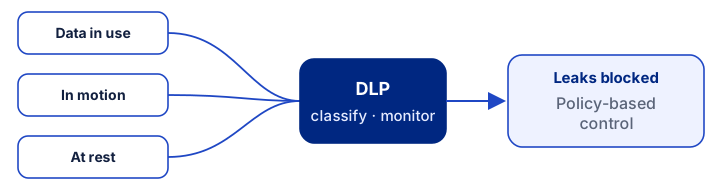
A true Enterprise DLP strategy covers data everywhere it lives: at rest, in motion, and in use.
- Data Discovery & Classification (Data at Rest): Automatically scan your servers, databases, endpoints, and cloud storage (like Office 365 or Google Drive) to identify exactly where sensitive data resides. Automatically tag and classify documents based on their risk level.
- Endpoint Protection (Data in Use): Deploy lightweight agents to employee laptops to prevent them from copying sensitive data to unencrypted USB drives, printing confidential documents, or taking screenshots of sensitive applications.
- Network Monitoring (Data in Motion): Inspect outbound web traffic, file transfers, and corporate email to block the transmission of restricted information outside the company. If an employee tries to email a spreadsheet of customer credit card numbers to their personal Gmail, the DLP system will block it and alert security.
- Compliance Reporting & Auditing: Generate the detailed audit logs and compliance reports required by Egyptian regulators and internal governance boards to prove that sensitive data is being actively protected.
Why Egyptian Enterprises Need DLP
While firewalls and antivirus protect you from outside hackers, DLP protects you from insider threats.
Whether it is a malicious employee attempting to steal a client database before resigning, or a well-meaning employee accidentally uploading a confidential contract to a public cloud storage site, the risk is real. DLP prevents the breach before it happens.
For banks, telecom operators, and healthcare providers across Egypt, a data breach isn't just an IT problem; it results in massive regulatory fines, loss of customer trust, and severe reputational damage.
Addressing Insider Threats and Accidental Data Leaks
While firewalls and antivirus protect your data from external hackers, they do nothing to stop insider threats. Data loss usually happens from the inside. A frustrated salesperson might dump your CRM to a USB, or HR might email payroll to the wrong client.
Enterprise Data Loss Prevention (DLP) solutions actively monitor data in motion, data at rest, and data in use, instantly blocking unauthorized transfers of intellectual property or Personally Identifiable Information (PII).
Meeting Regulatory Compliance in the Egyptian Market
Regulatory scrutiny in Egypt is at an all-time high. The Egyptian Personal Data Protection Law (PDPL), Central Bank of Egypt (CBE) frameworks, and international standards like GDPR or PCI-DSS require organizations to strictly control and audit who accesses sensitive information. Our Symantec and Cohesity DLP deployments include automated data discovery.
The system continuously scans your file servers, cloud environments, and databases to locate unencrypted credit card numbers, national ID numbers, and financial records. It then automatically applies encryption or strict access controls, so you pass your next compliance audit with flying colors.
Symantec DLP vs. Cohesity DataGovern: Choosing the Right Approach
Symantec DLP is built for real-time policy enforcement. It blocks a USB copy or an outbound email the moment it happens, using granular content-inspection rules for credit card numbers, national ID formats, and custom data patterns. It's the stronger choice when the priority is stopping a leak in the exact moment it's attempted.
Cohesity DataGovern instead focuses on data discovery and governance across your storage estate. It finds where sensitive data already sits — including in old backups and forgotten file shares — and classifies it. This is the essential first step before any enforcement policy can be written intelligently. Most of our Egyptian deployments combine both: Cohesity for discovery and classification, Symantec for real-time endpoint and network enforcement.
DLP for Egyptian Financial Institutions and Healthcare Providers
Banks and insurers operating under Central Bank of Egypt oversight face some of the strictest data-handling expectations in the market, particularly around customer financial records and card data. Healthcare providers managing patient records face similar sensitivity, without always having the same compliance infrastructure banks have already built.
For both sectors, the starting point is the same: know exactly where sensitive data lives before deciding how to protect it. WASS Technologies begins every DLP engagement with a discovery phase. We scan file servers, email systems, and cloud storage to build an accurate map of where regulated data actually sits, rather than assuming it's only in the systems it's supposed to be in.
This discovery phase pairs naturally with our broader data storage and management and SIEM engagements for clients who need visibility across their whole data estate, not just DLP in isolation.
Frequently Asked Questions (FAQs)
Will DLP block legitimate business processes? Not if implemented correctly. WASS Technologies uses a phased approach. We start in "Monitor Only" mode to understand your business workflows. We then carefully tune the rules and only move to "Blocking" mode once we are certain legitimate business processes won't be disrupted.
Can DLP scan scanned images or PDFs for sensitive data? Yes. Advanced enterprise DLP solutions incorporate Optical Character Recognition (OCR) to detect sensitive data even if it is embedded inside an image file or a scanned PDF.
What's the difference between Symantec DLP and Cohesity DataGovern? Symantec DLP enforces policies in real time at the endpoint and network layer, blocking unauthorized transfers as they happen. Cohesity DataGovern focuses on discovering and classifying sensitive data across your storage estate first. Most Egyptian deployments use both together.
How long does a DLP rollout typically take? A phased rollout — discovery, policy design, monitor-only tuning, then enforcement — typically takes six to ten weeks for a mid-sized Egyptian enterprise, depending on how many data sources and endpoints are in scope.
Does DLP work for remote and hybrid employees? Yes. Endpoint DLP agents enforce the same policies whether an employee is in the office, on a home network, or traveling, and continue reporting status back to your security team over any internet connection.
Further reading: Egypt PDPL Compliance Guide
Free tool: Gauge your readiness with our PDPL compliance self-assessment.
Related solutions: Data Encryption · Data Governance
Ensure Data Compliance and Security
Data is the lifeblood of your enterprise. Protect your most valuable assets from insider threats and accidental leaks.
Related AI solution: Symantec AI
Contact our data protection experts to discuss your DLP strategy across Egypt