
What Is NDR (Network Detection and Response)?
QUICK ANSWER
NDR (Network Detection and Response) analyses your network traffic and metadata to detect threats that endpoint tools cannot see — attackers moving laterally between systems, compromised hosts communicating with command-and-control servers, and malicious activity on devices that cannot run a security agent. It is a key layer for catching intruders who are already inside.
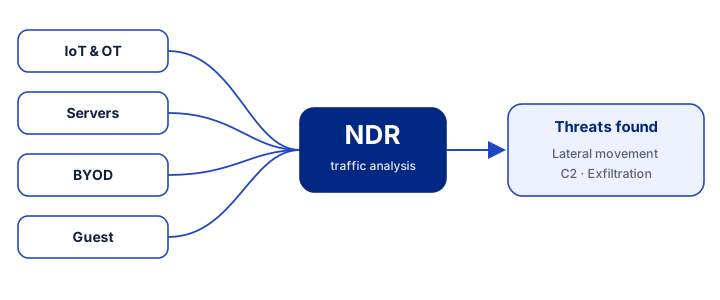
Even the best endpoint protection has a blind spot: the many network devices that cannot run an agent, and the traffic flowing between systems. NDR fills that gap. This guide explains what NDR is, how it works, and how it fits alongside the tools you already have.
Why Network Visibility Matters
Once attackers breach a single system, they rarely stay put — they move laterally, hunting for valuable data and higher privileges, and they communicate with external servers to receive commands and exfiltrate data. Much of this activity never touches a protected endpoint.
Networks are also full of unmanaged devices — IoT, operational technology, printers, guest and BYOD systems — that endpoint tools simply cannot cover. Watching the network itself is the only way to see this.
Encrypted Traffic Benchmark
90%+ of C2 Traffic Is Encrypted: Over 90% of malicious adversary command-and-control communications hide within encrypted TLS traffic, requiring NDR behavioral network metadata analytics to detect (Gartner NDR Research).
How NDR Works
NDR continuously analyses traffic flows and metadata across your internal network. Rather than matching known signatures, it uses behavioural analysis and machine learning to learn what normal looks like, then flags the anomalies that signal an intrusion — a host suddenly scanning the network, unusual outbound connections, or suspicious use of credentials. Crucially, it can detect threats hiding in encrypted traffic by analysing patterns, without needing to decrypt.
NDR vs EDR
- EDR protects managed endpoints in depth but cannot see agentless devices or the traffic between systems.
- NDR watches the network and every device on it, including those without agents, but does not have the deep on-device context EDR provides.
- Together they cover each other's blind spots — endpoint and network — which is why both are core telemetry sources for XDR.
Where NDR Fits in a Modern SOC
NDR is most valuable as part of a layered detection strategy. Feeding a SIEM, it adds network context to your logs; inside an XDR platform, it becomes a correlated telemetry source so a single incident shows an attacker's full path across endpoint and network. This connected view is what lets a security team understand and stop an intrusion quickly.
Common NDR Use Cases
Organisations turn to NDR for several recurring reasons: detecting lateral movement after an initial breach, before it becomes a full compromise; securing environments full of unmanaged devices such as IoT, operational technology and specialised equipment; spotting data exfiltration through unusual outbound traffic; and adding network context to investigations so analysts can understand the full scope of an incident. In each case, NDR reveals what endpoint-only tools cannot.
NDR for Egyptian Enterprises
Organisations with large, mixed networks — telecom, government, utilities and manufacturing in Egypt — gain the most from NDR, because their environments are full of operational and unmanaged devices. WASS Technologies deploys NDR solutions using Sophos and Kaspersky, tuned to your network.
Where NDR Fits Against the Attack Chain
NDR is powerful because it sees the stages of an attack that unfold on the network. After an initial foothold, attackers perform reconnaissance, move laterally, escalate privileges and communicate with external command-and-control — activities that leave clear traces in network traffic even when they avoid protected endpoints. By detecting these behaviours, NDR can catch an intrusion in progress, often before data is stolen or ransomware is deployed.
This is why network detection is increasingly seen as one of three pillars of modern detection alongside endpoint (EDR) and log analysis (SIEM) — a model sometimes called the SOC visibility triad. Each sees what the others cannot, and together they leave attackers far fewer places to hide. WASS helps Egyptian organisations add the network pillar with Sophos and Kaspersky, closing the gap that endpoint-only visibility leaves.
Frequently Asked Questions (FAQs)
Does NDR require agents on devices? No — it analyses network traffic and metadata, so it sees devices that cannot run endpoint software, like IoT and OT.
Is NDR the same as a firewall or IDS? No — it uses behavioural analysis to detect anomalies moving inside the network, including in encrypted traffic.
Do I need NDR if I already have EDR? They cover different ground — EDR sees endpoints, NDR sees the network and agentless devices; together they close each other's blind spots.
Learn more: NDR Solutions · EDR Security · XDR Security
Find Your Network Blind Spots
Ask our team across Egypt for a network visibility assessment — we show which devices and traffic your current tools cannot see and how NDR would cover them.
Talk to our team across Egypt